
JavaScript SEO Agency That Fixes What Google (and AI) Can't See
Your JavaScript-powered site might look perfect to visitors, but invisible to search engines. We diagnose and fix rendering, crawling, and indexing failures across React, Angular, Vue.js, and Next.js applications so your content actually ranks on Google and gets cited by ChatGPT, Gemini, and Perplexity.




100 + happy Clients
We’re trusted by:




Your JavaScript Is Hiding Your Best Content From Search Engines
Search for any page on your site using Google’s URL Inspection tool. Compare View Source against the rendered DOM. If those two versions don’t match, you have a JavaScript SEO problem. 98.8% of websites use JavaScript, but most development teams miss this: Googlebot doesn’t process your JavaScript the way a browser does. It crawls the raw HTML first and queues rendering for later. If your content only exists after JavaScript executes, it’s waiting in line while competitors’ server-rendered pages get indexed immediately.
And that’s just Google. AI search engines like ChatGPT, Perplexity, and Gemini don’t execute JavaScript at all. Their crawlers read raw HTML only. If your site relies on client-side rendering, you’re invisible to the fastest-growing search channel in a decade. That’s not a hypothetical. That’s a revenue problem happening right now.

Our JavaScript SEO Services Built for Every Framework
From technical audits and keyword strategy to content optimization, local SEO, link building, and guest outreach, our full-service SEO approach covers every aspect of search engine success. We combine advanced strategies, semantic optimization, and data-driven insights to boost rankings, drive qualified traffic, and turn your website into a growth engine.
JavaScript Rendering Audit
We analyze how Googlebot and AI crawlers see your site versus how users see it. Using URL Inspection, log file analysis, and headless browser comparisons, we map every gap between your source HTML and rendered DOM. You get a prioritized fix list tied to traffic impact, not just a technical spreadsheet.
Server-Side Rendering Setup
If your single-page application serves empty HTML shells to crawlers, that's the root problem. We implement SSR solutions using Next.js, Nuxt.js, or framework-specific configurations so search engines receive fully rendered content on the first request, without waiting in Google's render queue.
React, Angular & Vue.js SEO
Each JavaScript framework breaks SEO in different ways. React apps often miss meta tags until hydration completes. Angular's hashbang routing creates crawl dead-ends. Vue.js components can trap content inside shadow DOM elements. We fix framework-specific issues that generic SEO agencies miss entirely.
Core Web Vitals & JS Performance
When your Core Web Vitals scores tank because of render-blocking scripts, bloated bundles, or unoptimized hydration, rankings suffer. We reduce JavaScript payload sizes, implement code splitting, configure lazy loading, and optimize Largest Contentful Paint, Interaction to Next Paint, and Cumulative Layout Shift to meet Google's performance thresholds.
Schema in JavaScript
Injecting JSON-LD through JavaScript is standard practice, but it fails if the script errors out or if the structured data isn't present in the rendered HTML that Googlebot processes. We validate schema implementation across your JS stack and ensure Organization, FAQ, Product, and Article markup renders correctly for both Google and AI search engines.
JS SEO Monitoring
How do you know if your JavaScript SEO fixes actually worked? We set up monitoring dashboards that track indexation rates, render success, crawl stats from Google Search Console, and AI citation visibility so you can see the before-and-after in real numbers, not assumptions.
JavaScript SEO By the Numbers
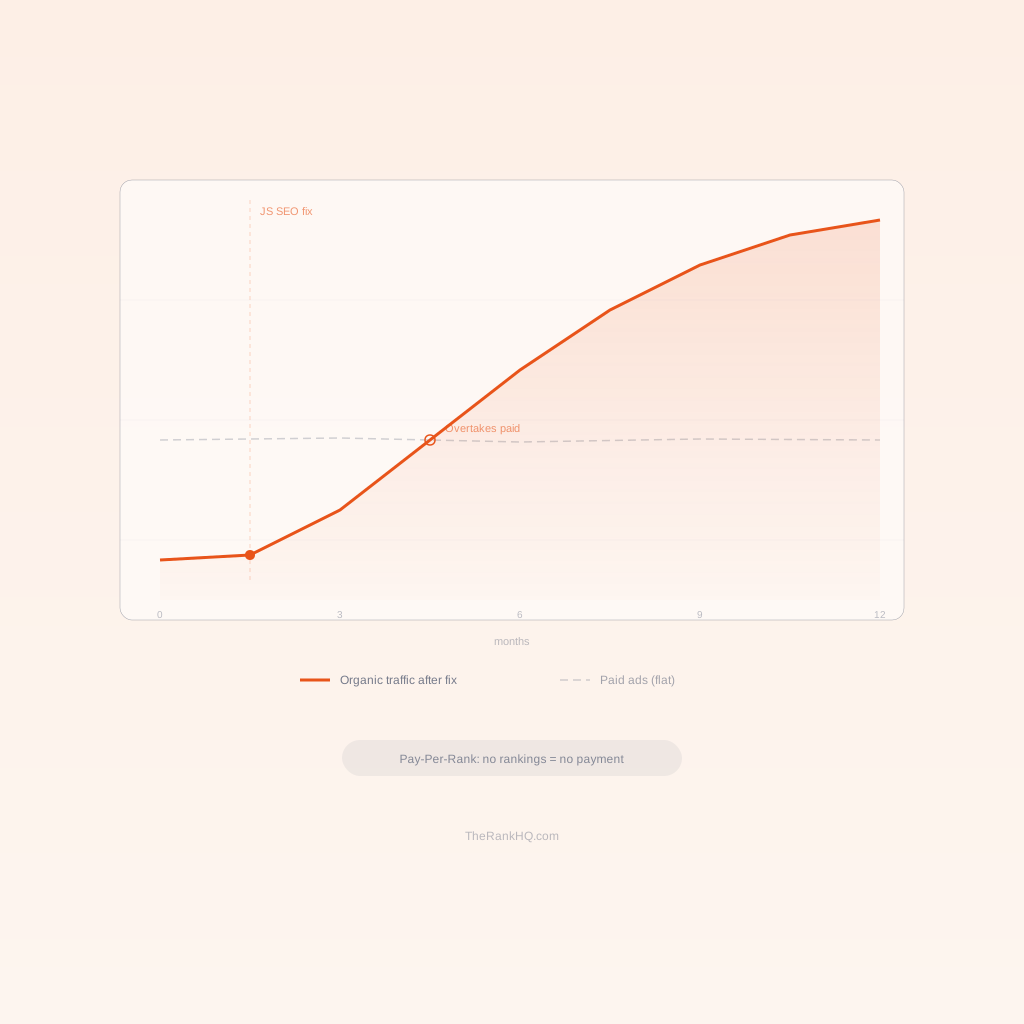
These aren’t abstract numbers. They’re the reason every dollar you put into seo for JavaScript compounds, while every dollar you put into paid ads disappears the second you stop paying.
98.8% of all websites use JavaScript as a client-side programming language
9x longer for Google to crawl JavaScript content compared to plain HTML
0% of AI search crawlers (ChatGPT, Perplexity, Claude) execute JavaScript when indexing content
62.3% of developers use JavaScript as their primary programming language
3-6 months typical timeline for measurable improvements after JavaScript SEO implementation
Expert JavaScript SEO for Your Business Type
No matter what your site is built on or who it serves, JavaScript rendering issues don’t discriminate. We’ve fixed indexing problems across every major industry.
Product page rendering, faceted navigation crawlability, and dynamic filter indexing for JavaScript-powered ecommerce stores
SaaS & Technology
Single-page application SEO, feature page indexing, and documentation site rendering for software companies
Healthcare
HIPAA-compliant patient portal indexing and medical content rendering with proper schema validation
Practice area page rendering, attorney profile indexation, and YMYL compliance for JavaScript-built law firm sites
IDX listing rendering, property search indexation, and map-based search crawlability
Financial Services
Secure application rendering, product comparison tool indexing, and calculator widget accessibility
Media & Publishing
Infinite scroll article indexing, dynamic content loading, and paywall implementation that preserves SEO
Education & Training
Course catalog rendering, learning platform indexing, and interactive content crawlability
Our 6-Step JavaScript SEO Framework
We’ve refined this process across dozens of JavaScript-heavy sites, from React SPAs to Angular enterprise platforms. Every step is built to solve the specific rendering, crawling, and indexing challenges that JavaScript creates.
JavaScript SEO Audit
We start with a full JavaScript SEO audit using Screaming Frog’s JavaScript rendering mode, Google Search Console’s URL Inspection tool, and server log analysis. We compare your raw HTML against the rendered DOM for every critical page template. The deliverable is a gap report showing exactly which content, links, and metadata Google can’t see, ranked by revenue impact. This isn’t a generic technical audit. It’s a JavaScript-specific diagnostic built on how Googlebot’s Web Rendering Service actually processes your pages.
Rendering Strategy Selection
Not every JavaScript site needs the same fix. Based on your framework, hosting setup, traffic volume, and content update frequency, we recommend the right rendering approach: server-side rendering (SSR), static site generation (SSG), incremental static regeneration (ISR), dynamic rendering, or pre-rendering. We map each solution against your development resources and timeline so the recommendation is actually implementable. A React SPA with 50 pages needs a different strategy than an Angular enterprise app with 50,000.
Technical Implementation
This is where fixes happen. We work with your development team (or handle it directly) to implement the approved rendering strategy. For Next.js and Nuxt.js migrations, we configure SSR and SSG routes. For legacy SPAs, we set up pre-rendering services like Prerender.io or Rendertron. We fix client-side routing issues, implement proper canonical tags, configure meta tag injection through React Helmet or Vue Meta, and ensure internal links exist in the initial HTML response.
Content Accessibility & Internal Link Recovery
Rendering is step one. Making that content rank is step two. Once search engines can see your pages, we audit the actual content quality, internal linking structure, and on-page SEO. JavaScript sites often have broken internal link architectures because navigation elements and contextual links are generated dynamically. We rebuild the link graph so that crawl equity flows properly across your site.
Performance Optimization
JavaScript bloat kills Core Web Vitals scores. We reduce bundle sizes through code splitting and tree shaking, defer non-critical scripts, optimize images loaded through JS, and implement efficient lazy loading patterns. Every performance improvement directly impacts crawl efficiency, because Google allocates more crawl budget to faster sites. We target LCP under 2.5 seconds, INP under 200ms, and CLS under 0.1.
Monitoring & Ongoing Optimization
JavaScript SEO isn’t a one-time fix. Every code deployment can break rendering. Every new feature can introduce crawl issues. We set up automated monitoring through Google Search Console API integrations, crawl monitoring dashboards, and monthly rendering audits. When something breaks, we catch it before Google does. Monthly reports show indexation rates, crawl stats, organic traffic trends, and AI search citation tracking.
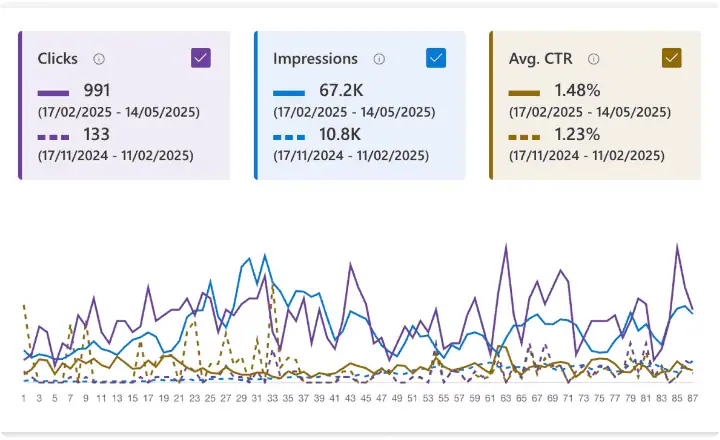
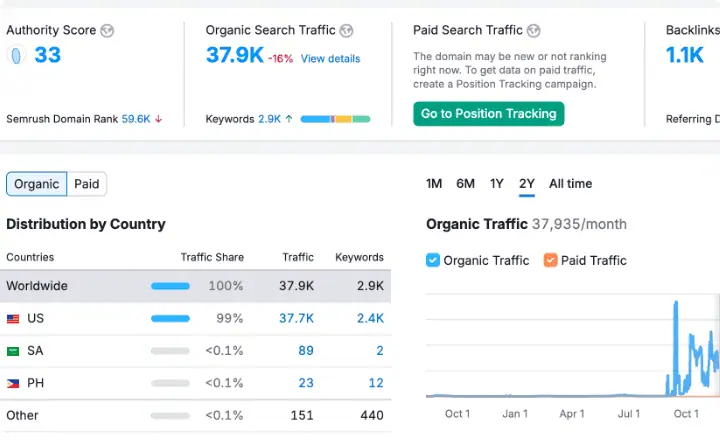
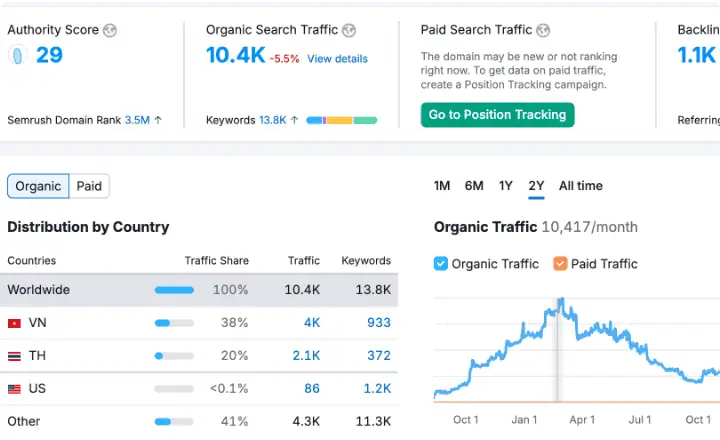
Real Results From Fixing JavaScript SEO Issues
These aren’t hypothetical scenarios. These are client sites where rendering and indexing fixes directly translate to traffic and revenue growth.
How We Fix JavaScript SEO Issues
We don’t guess. Every recommendation comes from testing how Googlebot and AI crawlers actually process your specific implementation. Here’s the detail behind each phase.
- JavaScript SEO Audit
- Rendering Strategy
- Technical Implementation
- Site's SEO Foundation
- Performance Optimization
- Monitoring & Optimization
Full-Stack JavaScript Rendering Diagnosis
A JavaScript SEO audit goes far beyond a standard site crawl. We need to understand what your site looks like to Googlebot’s Web Rendering Service versus what it looks like to a human visitor. The gap between those two versions tells us everything.
- Crawl your entire site with JavaScript rendering enabled and disabled, comparing output for every page template
- Analyze server logs to identify pages Googlebot requests but never indexes (render queue failures)
- Test live URLs through Google Search Console’s URL Inspection to verify actual rendered HTML
- Check AI crawler accessibility by testing raw HTML response against ChatGPT, Perplexity, and Gemini crawler user agents
- Map every JavaScript-dependent element: navigation links, content blocks, meta tags, canonical URLs, structured data, and image sources
Choosing the Right Rendering Architecture
The rendering strategy decision is the most consequential choice in JavaScript SEO. Get it wrong and you waste months of development time. We match the solution to your actual constraints, not to what’s trendy.
- Evaluate your current framework (React, Angular, Vue, Svelte) for SSR compatibility and migration complexity
- Benchmark server resources required for SSR versus the cost of pre-rendering or dynamic rendering services
- Test incremental static regeneration suitability for sites with frequently updated content (product catalogs, listings, news)
- Document the decision rationale with pros, cons, and estimated development effort for each option
- Create a phased implementation roadmap so critical pages get fixed first while the full migration continues
Rendering Fixes and Framework Configuration
Implementation is where most JavaScript SEO projects fail. Agencies deliver audit reports and walk away. We stay in the codebase (or in direct communication with your developers) until every fix is verified in production.
- Configure SSR/SSG for critical page templates (homepage, category pages, product pages, service pages)
- Fix client-side routing to ensure every URL returns proper HTTP status codes and canonical tags from the server
- Implement meta tag management through framework-specific solutions (React Helmet, Vue Meta, Angular Universal)
- Resolve hydration mismatches that cause content flicker and confuse Googlebot’s rendering comparison
- Set up proper HTTP caching headers with content fingerprinting to prevent Googlebot from using outdated JavaScript resources
Content Accessibility & Link Recovery: Rebuilding Your Site’s SEO Foundation
Once crawlers can see your content, we need to make sure what they see is worth ranking. JavaScript sites often accumulate content problems that go unnoticed because the site looks fine to humans.
- Audit all internal links to verify they exist in the initial HTML, not just in the rendered DOM
- Fix JavaScript-generated navigation menus that create orphaned pages invisible to crawlers
- Recover lost link equity from broken or JavaScript-dependent internal links
- Optimize content that was previously invisible to ensure keyword targeting, heading hierarchy, and on-page SEO are properly configured
- Implement proper pagination handling for infinite scroll interfaces (converting to paginated URLs with rel=next/prev or load-more patterns that preserve crawlability)
JavaScript Performance That Impacts Rankings
Speed isn’t just a user experience metric. For JavaScript sites, performance directly determines how much of your content Google can process within its crawl budget and render capacity.
- Analyze and reduce JavaScript bundle sizes using code splitting, tree shaking, and dynamic imports
- Defer non-critical third-party scripts (analytics, chat widgets, ad scripts) that block rendering
- Optimize Largest Contentful Paint by preloading critical resources and reducing server response times
- Fix Cumulative Layout Shift caused by late-loading JavaScript components that shift page content
- Implement service workers for faster repeat visits and better Core Web Vitals performance
Continuous JavaScript SEO Protection
Every sprint, every deployment, every new feature release can break rendering. Without monitoring, you won’t know until traffic drops and by then, you’ve lost weeks of rankings.
- Connect Google Search Console API for real-time indexation tracking and crawl error alerts
- Set up automated rendering tests that run after every deployment (CI/CD pipeline integration)
- Monitor AI search citation rates across ChatGPT, Gemini, and Perplexity monthly
- Track Core Web Vitals trends and flag performance regressions before they impact rankings
- Deliver monthly JavaScript SEO health reports with indexation rates, crawl stats, and traffic attribution
SSR vs CSR vs Dynamic Rendering: Which Approach Fits Your Site?
Choosing the right rendering strategy is the biggest decision in JavaScript SEO. Here’s how the four main approaches compare on the factors that actually matter for search visibility.
| Factor | Server-Side Rendering (SSR) | Client-Side Rendering (CSR) | Dynamic Rendering | Pre-rendering / SSG |
|---|---|---|---|---|
| Google Crawlability | Excellent. Content in initial HTML response. | Delayed. Depends on render queue. | Excellent for bots. Serves pre-rendered version. | Excellent. Static HTML files. |
| AI Search Visibility | Full visibility. Raw HTML contains content. | Invisible. AI crawlers don't execute JS. | Full visibility for bot user agents. | Full visibility. Static files. |
| Development Complexity | Medium-High. Requires SSR-compatible framework. | Low. Standard SPA setup. | Medium. Requires rendering service setup. | Low-Medium. Build-time generation. |
| Best For | Content-heavy sites, ecommerce, blogs | Internal apps, dashboards (not SEO-dependent) | Large legacy SPAs, phased migrations | Marketing sites, documentation, small catalogs |
| Performance Impact | Good. First paint from server. Hydration needed. | Poor initial load. All rendering client-side. | Mixed. Two versions to maintain. | Excellent. Pure static HTML. |
| Content Freshness | Real-time. Every request renders fresh. | Real-time on client. Hidden from crawlers. | Depends on cache/refresh frequency. | Stale unless rebuilt. ISR solves this partially. |
| Recommended Frameworks | Next.js, Nuxt.js, Angular Universal, SvelteKit | React (CRA), Vue (SPA mode), Angular (default) | Any SPA + Rendertron or Prerender.io | Next.js (SSG), Gatsby, Astro, Hugo |
There’s no universal “best” rendering strategy. A SaaS company with 200 feature pages and daily content updates needs SSR through Next.js or Nuxt.js. An enterprise with a 10-year-old Angular application and 50,000 URLs might start with dynamic rendering as a bridge solution while planning a phased SSR migration. A small agency site with 30 pages might be best served by static generation. We help you choose based on your real constraints, not a textbook recommendation.
Stop Losing Traffic to JavaScript Rendering Failures
Your JavaScript site might look flawless to users but broken to search engines. A free audit shows you exactly what Google and AI crawlers can’t see, and what it’s costing you.
Why JavaScript SEO Is the Highest-ROI Fix You're Not Making
Here’s the math that makes JavaScript SEO an obvious investment. If Google can only index 60% of your pages because of rendering issues, you’re leaving 40% of your potential organic traffic on the table. That’s not a slow leak. That’s a dam with a hole in it.
Most businesses spend $5,000-$15,000 per month on paid ads to drive traffic that organic search could deliver for free, if their JavaScript wasn’t blocking indexation. A one-time rendering fix plus ongoing monitoring typically costs a fraction of that monthly ad budget and produces compounding returns as indexed pages accumulate rankings over time.
The AI search angle makes the ROI case even stronger. ChatGPT, Gemini, and Perplexity are growing rapidly as product and service discovery channels. Every one of those platforms reads raw HTML. If your site serves empty div tags until JavaScript executes, you’re invisible to the next generation of search. Fixing rendering now means you capture both Google traffic and AI search citations simultaneously.
Our Performance based seo model reduces your risk further. You invest in the technical fixes, and you only pay for SEO results when rankings are actually achieved.
Get Found Where AI Search Actually Looks
AI crawlers don’t execute JavaScript. That means server-side rendering isn’t optional anymore. It’s the price of entry for AI search visibility. We optimize your site’s raw HTML output so these platforms can read, cite, and recommend your content.
JavaScript Frameworks We've Fixed and Ranked
We’ve diagnosed and resolved SEO issues across every major JavaScript framework. The rendering problems differ for each one, and so do the solutions.
Why Choose TheRankHQ as a JavaScript SEO Company?
Most SEO agencies run a standard audit, see rendering issues, and shrug. They don’t have developers on staff who understand the difference between a hydration mismatch and a layout shift. We do.
We Actually Read Your Code
We review your React components, Angular modules, and Vue.js templates directly. When we say "fix your rendering," we can show your dev team the exact code edit. That saves weeks of back-and-forth translation between SEO recommendations implementation.
Google + AI Search
Fixing Google rendering is half the job. AI search engines process raw HTML only. We configure your rendering pipeline so both Google's Web Rendering Service and AI crawlers like ChatGPT and Perplexity see your full content. One implementation, two search channels covered.
Pay-Per-Rank Model
JavaScript SEO fixes are an investment. Our Pay-Per-Rank model means you pay for the technical implementation, but SEO performance fees only kick in when rankings are achieved. If we don't deliver results, you don't pay for results.
We Don't Just Audit,
Audit reports collect dust. We stay involved through implementation, working directly with your engineering team or handling the rendering configuration ourselves. You get a partner who ships fixes, not a consultant who ships PDFs.
Framework-Specific Process
Our audit and implementation process is different for React than it is for Angular. Different for Next.js than for Gatsby. We've built framework-specific playbooks because the SEO problems (and solutions) are different for each one. What works on a Vue.js SPA will break an Angular Universal app.
Transparent Reporting
Our monthly reports include indexation rates by page template, crawl stats from log files, Core Web Vitals trends, rendering success rates, and AI citation tracking. Every metric is tied to a business outcome. Your marketing team sees traffic impact. Your dev team sees the technical detail.
JavaScript SEO Myths We Hear Every Week
A lot of owners are skeptical about JavaScript SEO. That’s fair. The industry has been burned by agencies making big promises with nothing to show for it. But some of the most common objections we hear are based on outdated assumptions, not current reality.
Myth: "JavaScript is bad for SEO."
Not true. JavaScript itself isn’t the problem. The rendering strategy is. A Next.js site with server-side rendering can outperform a static HTML site because it combines rich interactivity with full crawlability. The issue arises only when content depends entirely on client-side JavaScript execution without any server-rendered fallback. Blame the implementation, not the language.
Myth: "A sitemap will solve my JavaScript indexing problems."
Sitemaps tell Google which URLs exist. They don’t tell Google what those URLs contain. If your pages serve empty HTML shells that require JavaScript to populate content, a sitemap just creates a longer list of pages Google can’t fully process. Discovery and indexing are two different things.
Myth: "Pre-rendering is a hack and Google penalizes it."
Pre-rendering (or dynamic rendering) is explicitly recommended by Google as a valid approach for JavaScript-heavy sites. Google’s documentation includes it as a solution for sites that can’t implement server-side rendering. It’s not cloaking. You’re serving the same content to bots and users, just delivered through a different rendering path. Google’s John Mueller has confirmed this repeatedly.
Myth: "If my site works in Chrome, Googlebot can see everything."
People are already asking ChatGPT “what’s the best [product] for [use case]?” If your brand isn’t showing up in those answers, someone else’s is. AI search optimization for ecommerce is early, and that’s exactly why it’s a competitive advantage right now.
What Our Clients Say About Working With TheRankHQ
Results speak louder than promises. Here’s what clients have to say about our SEO work:



FAQs About JavaScript SEO Services
Got questions? These are the ones we hear most from store owners before they start working with us.
JavaScript SEO is the practice of making JavaScript-powered websites fully crawlable, renderable, and indexable by search engines. When sites use frameworks like React, Angular, or Vue.js to generate content dynamically, search engines may struggle to see that content. JavaScript SEO fixes the gap between what users see and what Googlebot processes.
No. JavaScript isn't inherently harmful to SEO. The problem is how content gets delivered to search engine crawlers. A React app with proper server-side rendering through Next.js performs just as well as a static site. The risk appears only when critical content depends entirely on client-side rendering without a server-rendered fallback.
Yes, Google renders JavaScript using headless Chromium through its Web Rendering Service. But rendering happens in a separate queue with processing delays. Pages with complex JavaScript may wait hours or days for rendering. And if scripts fail, timeout, or error out during rendering, that content never gets indexed.
Next.js (React-based) and Nuxt.js (Vue-based) are the most SEO-friendly frameworks because they support server-side rendering and static generation out of the box. SvelteKit and Astro also score well. Angular works with Angular Universal for SSR. The "best" framework depends on your project requirements, but any framework can be made SEO-friendly with the right rendering configuration.
A thorough JavaScript SEO audit typically ranges from $2,000 to $10,000 depending on site size, framework complexity, and the number of page templates involved. Enterprise sites with 50,000+ URLs and multiple frameworks cost more than a 200-page Next.js marketing site. We scope every project individually after an initial review.
Server-side rendering generates the full HTML page on the server before sending it to the browser. This means Googlebot receives complete content on the first request, without waiting for JavaScript to execute. SSR eliminates render queue delays, ensures AI crawlers can read your content, and typically improves Core Web Vitals scores because the first paint happens faster.
No. AI search engine crawlers, including those from OpenAI (ChatGPT), Google (Gemini), and Perplexity, do not execute JavaScript. They process raw HTML only. If your site serves empty markup that gets populated by JavaScript after page load, these AI platforms can't see your content and won't cite or recommend your business in their responses.
Most sites see measurable improvements in indexation within 2-4 weeks after rendering fixes go live. Ranking improvements and traffic growth typically follow within 3-6 months, depending on competition, content quality, and how many pages were previously unindexed. Sites with severe rendering issues often see the fastest gains because they're recovering traffic that was previously blocked.
CSR (client-side rendering) builds the page entirely in the browser using JavaScript. SSR (server-side rendering) builds the page on the server and sends complete HTML. Dynamic rendering detects bot user agents and serves them a pre-rendered HTML version while users still get the standard JavaScript version. Each approach has different trade-offs for development effort, performance, and crawlability.
Yes. Not every site needs a full framework migration. For many legacy SPAs, dynamic rendering or pre-rendering services like Prerender.io provide immediate indexation improvements without touching your existing codebase. If a rebuild is warranted, our web design team builds SEO-optimized sites from day one. We evaluate the most practical path based on your current stack, budget, and timeline.
Heavily. JavaScript is the primary cause of poor Largest Contentful Paint (large bundles delaying first render), high Interaction to Next Paint (long tasks blocking the main thread), and Cumulative Layout Shift (late-loading components pushing content around). Optimizing JavaScript execution, reducing bundle sizes, and implementing proper loading strategies directly improve all three Core Web Vitals metrics.
JavaScript SEO sits at the intersection of front-end development and technical SEO. Your developers understand the code but may not know how Googlebot's rendering pipeline works. Your SEO team understands ranking factors but can't debug a hydration mismatch in React. A specialized agency that offers both technical SEO services and JavaScript expertise bridges that gap with people who speak both languages fluently.
Your JavaScript Site Deserves to Rank on Google and Get Cited by AI
We’ve fixed rendering issues, recovered lost indexation, and grown organic traffic for JavaScript-powered sites across React, Angular, Vue.js, and Next.js.