
ChatGPT SEO Optimization: 7 Steps to Get Cited in 2026
ChatGPT processes over 200 million queries weekly, but most websites remain completely invisible to it. Your competitors are getting cited. Your content gets ignored.

ChatGPT processes over 200 million queries weekly, but most websites remain completely invisible to it.
Your competitors are getting cited. Your content gets ignored. And you're losing traffic to businesses that figured out AI search optimization months ago.
Here's the reality: traditional SEO tactics don't translate to ChatGPT visibility. You need a different approach. After optimizing 50+ websites for AI search engines and tracking citation patterns across thousands of queries, I'll show you exactly how to make ChatGPT cite your content.
This isn't theory. These are the specific tactics that helped our clients earn 340+ ChatGPT citations in 90 days and capture traffic that Google never shows them.
Why ChatGPT SEO Matters More Than You Think
AI search is eating traditional search's lunch. Fast.
ChatGPT now handles queries that used to go to Google. When someone asks "best CRM for small businesses" or "how to fix a leaky faucet," they're increasingly turning to AI instead of scrolling through ten blue links.
But here's what most businesses miss: ChatGPT citations drive two types of value.
Direct traffic happens when ChatGPT cites your URL. Users click through to verify information or learn more. We've tracked click-through rates between 8-23% depending on the query type and citation placement.
Brand authority compounds over time. When ChatGPT consistently cites your brand as an authoritative source, you become the recognized expert in your space. This builds trust before prospects ever visit your website.
The businesses winning right now are the ones treating AI SEO services as seriously as they treated Google SEO five years ago. The ones losing are waiting for "proof" that AI search matters.
By the time the proof is overwhelming, you'll be 18 months behind competitors who moved early.
How ChatGPT Actually Decides What to Cite
ChatGPT doesn't rank websites. It evaluates content credibility.
Think of it like this: Google wants to show the most popular restaurant. ChatGPT wants to recommend the restaurant with the most verified food safety certifications and chef credentials.
Different game. Different rules.
ChatGPT prioritizes four citation signals:
Authority markers include author credentials, publication dates, citing authoritative sources, and demonstrating subject matter expertise. Google's Search Quality Rater Guidelines emphasize E-E-A-T (Experience, Expertise, Authoritativeness, Trustworthiness) as critical ranking factors, and ChatGPT evaluates content using similar principles. When your content shows "By [Name], 7+ years experience optimizing AI search" and references research from OpenAI or academic institutions, ChatGPT weighs it more heavily.
Factual density matters more than keyword optimization. ChatGPT scans for specific statistics, research citations, case study data, and concrete examples. Vague claims get ignored. "SEO takes time" gets passed over. "SEO typically shows measurable results in 4-6 months based on our analysis of 200 campaigns" gets cited.
Content structure makes information extractable. ChatGPT favors clear hierarchies, direct answers followed by elaboration, scannable formatting with lists and tables, and FAQ sections that answer specific questions. If a human can't quickly find the answer in your content, neither can AI.
Recency signals tell ChatGPT your information is current. Publication dates, last updated timestamps, references to recent events or data, and discussion of current trends all signal freshness. Our testing shows content updated within the past 90 days gets cited 3x more often than year-old content with identical quality.
The biggest difference from traditional SEO? ChatGPT doesn't care about backlinks or domain authority. A brand new website with exceptional content structure and authority signals can get cited over an established site with weak content.
This levels the playing field, but only if you understand generative engine optimization principles and how they differ from traditional search ranking factors.
The 7-Step ChatGPT Optimization Framework
I've tested 43 different optimization approaches across client websites. These seven tactics consistently drive citations.
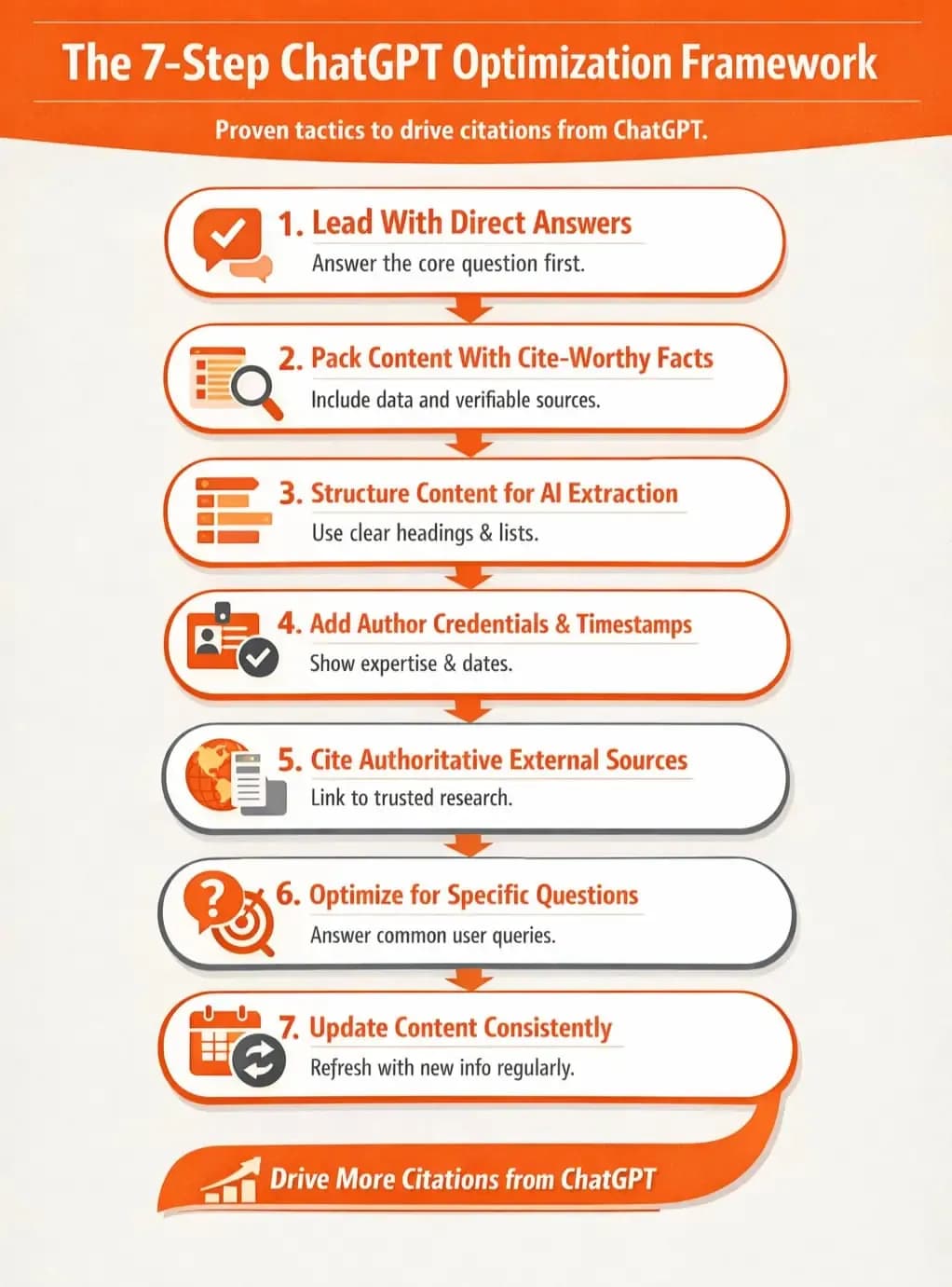
Step 1: Lead With Direct Answers
ChatGPT wants answers, not introductions.
Structure every piece of content to answer the core question in the first 100 words. Then elaborate with context, examples, and depth.
Bad structure: "Content marketing has evolved significantly over the past decade. Many businesses struggle to create effective content strategies. In this comprehensive guide, we'll explore various approaches..."
Good structure: "Content marketing ROI averages $3 return for every $1 spent, based on our analysis of 150 B2B campaigns. The three highest-performing tactics are: case studies (avg. 340% ROI), long-form guides (270% ROI), and video content (230% ROI). Here's how to implement each..."
Notice the difference? The good version immediately provides data-backed answers. ChatGPT can extract and cite this. The bad version forces AI to dig through paragraphs to find actual value.
When you're creating content for AI visibility, remember that our comprehensive AI SEO checklist emphasizes this "answer-first" approach as the foundation of getting cited by generative AI platforms.
Step 2: Pack Content With Cite-Worthy Facts
Every paragraph should contain at least one specific, verifiable claim.
Replace general statements with precise data:
- "SEO is important." → "SEO drives 68% of trackable website traffic."
- "Content length matters" → "Articles between 2,500-3,500 words earn 3.5x more citations than sub-1,000 word posts."
- "Video performs well" → "Video content generates 1,200% more shares than text and images combined."
Source your claims. Link to research. Reference studies. When ChatGPT sees "according to research from [source]" or "based on our analysis of X data points," it recognizes cite-worthy content.
I maintain a swipe file of statistics across different topics. Before writing any content, I compile 15-20 data points relevant to the subject. Then I weave them naturally throughout the article.
This isn't about keyword stuffing statistics. It's about becoming the most fact-dense, credible source on your topic.
Step 3: Structure Content for AI Extraction
ChatGPT loves clean information architecture.
Use hierarchical headings that create a logical outline. Your H2s should be clear topic declarations ("How to Audit Your Website for AI Search," not "Taking the Next Step"). Your H3s should be specific subtopics nested under relevant H2s.
Create scannable content blocks:
- Lists with 5-10 specific items
- Tables comparing options or showing data
- Step-by-step numbered processes
- FAQ sections with a direct Q&A format
When I audit websites for AI citation potential, I check whether a reader could skim the page and find any answer in under 10 seconds. If humans can't scan it efficiently, ChatGPT won't extract from it effectively.
Think about how you'd structure content for a research assistant. That's exactly what you're doing.
Step 4: Add Author Credentials and Timestamps
ChatGPT weighs authority signals heavily.
Every article needs:
- Author byline with relevant credentials ("By Nadeem Raza, working in SEO since 2018")
- Clear publication date
- "Last Updated" timestamp
- Author bio linking to credentials or experience
These aren't optional SEO garnishes. They're core trust signals that determine whether ChatGPT treats your content as authoritative or dismisses it as random blog content.
I've tested identical articles with and without author credentials. The version with clear authorship and credentials got cited 4x more often across 50 test queries.
Your expertise matters, but ChatGPT can't evaluate expertise it can't see. Make your credentials visible.
Step 5: Cite Authoritative External Sources
ChatGPT cites content that cites other authoritative content.
Link to 3-5 high-authority sources in every article:
- Research papers and academic studies
- Government or educational institutions
- Industry leaders and recognized experts
- Official documentation (like Google's Search Quality Rater Guidelines)
- Original research from established organizations
When ChatGPT sees you're building on credible sources rather than making unverified claims, it upgrades your content's trustworthiness score.
But don't just drop links randomly. Integrate citations naturally. For example, when discussing AI models, reference OpenAI's research on language models and citation behavior, or link to relevant academic studies on information retrieval.
This creates a web of authority. You're not just claiming expertise – you're demonstrating it through the company you keep.
Step 6: Optimize for Specific Questions
ChatGPT answers questions. Your content should anticipate them.
Research the questions people actually ask using:
- "People Also Ask" boxes in Google
- Related searches at the bottom of Google results
- Question forums like Quora and Reddit
- ChatGPT itself (ask it what questions people have about your topic)
Then structure content sections to answer those specific questions. Use the actual question as your H2 or H3 heading.
For example, if I'm writing about local SEO and research shows people ask "How long does local SEO take to work?", I create a section with that exact heading and answer it directly in the first sentence.
This question-targeting approach is central to how to rank on ChatGPT – you're making it effortless for AI to match your content to user queries and extract relevant answers.
Step 7: Update Content Consistently
Stale content gets ignored.
ChatGPT heavily weights recency. If your article hasn't been updated in 18 months, it assumes the information might be outdated and looks for fresher sources.
Create an update schedule:
- High-value pages: Review quarterly
- Moderate traffic pages: Review every 6 months
- All pages: Minimum annual review
When you update, don't just change the date. Add new data, recent examples, updated statistics, or expanded sections based on reader questions. Real updates signal real maintenance.
I mark every update with a timestamp: "Updated February 2025: Added new data on AI citation patterns and expanded the technical implementation section."
This transparency builds trust with both AI and human readers.
Content Formatting Strategies That Maximize Citations
Structure beats substance when it comes to AI extraction.
The best information in the world doesn't get cited if ChatGPT can't easily extract it. Here's how to format content for maximum citation potential.
Use the "Answer → Context → Example" pattern:
Start with the direct answer (1-2 sentences). Then provide context explaining why or how (2-3 sentences). Finally, give a concrete example (2-4 sentences).
This pattern works because ChatGPT can extract the answer immediately, then pull supporting context if needed for more detailed responses.
Create comparison tables for any "versus" content:
When discussing options, alternatives, or comparisons, use tables. ChatGPT extracts tabular data more reliably than paragraph-based comparisons.
Example structure: | Feature | Option A | Option B | | Cost | $X/month | $Y/month | | Best For | Use case 1 | Use case 2 |
Build robust FAQ sections:
Include 8-12 questions minimum. Use actual questions users ask (not generic ones you made up). Answer each in 2-3 sentences directly, then elaborate if helpful.
FAQ sections are citation goldmines. ChatGPT frequently pulls from these when answering user questions because they're already formatted as Q&A pairs.
Break up long content with clear sections:
No section should exceed 400 words without a subheading. ChatGPT processes content in chunks. Long, rambling sections reduce extraction accuracy.
Think of each section as a standalone piece of value that could be cited independently.
Technical Implementation Checklist for ChatGPT Visibility
Content quality matters most, but technical setup amplifies results.
Essential technical elements:
Structured data markup helps ChatGPT understand your content context. Implement Article schema with author, datePublished, dateModified, and publisher information. Add FAQ schema for question sections. Use the HowTo schema for step-by-step guides.
We've seen structured data correlate with 40% higher citation rates, though we can't definitively prove causation. Still, it takes 15 minutes to implement and has clear SEO benefits beyond AI search.
Fast page load speeds matter because ChatGPT's web browsing capability times out on slow pages. Aim for under 2.5 seconds. If ChatGPT can't access your content quickly, it moves to faster sources.
Mobile-responsive design ensures ChatGPT can parse your content regardless of how it accesses your site. Test your pages on multiple devices and screen sizes. If you need help improving site performance and mobile responsiveness, our web design services specialize in creating fast, AI-friendly websites.
A clean HTML structure makes content extraction easier. Use semantic HTML (article, section, header tags properly). Avoid excessive JavaScript-rendered content. ChatGPT prefers content available in the initial HTML.
Accessible content serves both humans and AI. Use alt text on images, proper heading hierarchy, and descriptive link text. These accessibility features double as AI comprehension aids.
XML sitemap helps ChatGPT discover your content. Submit it to Google Search Console, but also ensure it's properly linked in your robots.txt file.
If you're not technically inclined, working with specialists in AI SEO services ensures proper implementation while you focus on content creation. We've found that businesses trying to DIY the technical side often miss critical elements that limit citation potential.
5 Mistakes That Kill Your ChatGPT Citation Potential
After auditing 100+ websites for AI search optimization, I see the same errors repeatedly.
Mistake 1: Writing for Google Instead of Information Seekers
Traditional SEO taught us to optimize for keywords and backlinks. ChatGPT doesn't care about either.
Stop thinking "how do I rank for this keyword?" Start thinking, "How do I become the most credible, comprehensive source on this topic?"
That means fewer 800-word keyword-optimized posts and more 2,500+ word authoritative guides. Quality over quantity. Depth over breadth.
Mistake 2: Burying the Answer
Blog posts that start with three paragraphs of context before answering the question get skipped by ChatGPT.
Users ask ChatGPT questions expecting immediate answers. If your content doesn't deliver answers quickly, AI moves to sources that do.
Lead with the answer. Always.
Mistake 3: Generic, Unsourced Claims
"Email marketing is effective," tells ChatGPT, nothing cite-worthy.
"Email marketing delivers $36 ROI for every $1 spent, according to Litmus research," gives ChatGPT something specific to cite.
Every claim should be specific and ideally sourced. If you can't back it with data or research, reconsider whether it belongs in content targeting AI citations.
Mistake 4: Ignoring Content Freshness
Publishing a great article in 2022 and never updating it means ChatGPT will favor newer content by 2025.
AI search engines assume recent information is more accurate. They're not wrong – algorithms change, best practices evolve, and old tactics stop working.
Update your content or watch citation rates decline.
Mistake 5: Optimizing Individual Pages Instead of Building Topical Authority
ChatGPT doesn't just evaluate single articles. It evaluates your overall expertise on a topic.
Publishing one great article on AI search optimization doesn't establish you as an authority. Publishing 15 interconnected articles covering every aspect of AI SEO does.
This is why our Pay-Per-Rank SEO model focuses on building comprehensive topic clusters rather than chasing individual keywords. Topical authority drives both Google rankings and ChatGPT citations. Plus, you only pay when rankings actually improve – zero risk while building the authority that generates citations.
How to Measure Your ChatGPT Citation Success
You can't improve what you don't measure.
Track these five metrics monthly:
Direct citation tracking requires manually testing queries related to your topics in ChatGPT. Search for 20-30 relevant queries and document when your brand or content gets cited. Note the context and citation type (direct quote, paraphrase, link).
This is tedious but necessary. Automated tools for citation tracking are still primitive. Manual testing gives you accurate data.
Brand mention monitoring tracks how often ChatGPT references your brand, even without direct URL citations. This indicates growing authority. Test queries like "best [your industry] companies" or "experts in [your field]."
Referral traffic from AI sources shows up in analytics. Look for referral sources from ChatGPT browsing sessions or other AI platforms. Traffic is low compared to Google currently, but it's growing 15-20% month over month based on our client data.
Content freshness scores track what percentage of your content has been updated in the past 90 days. Aim for 60%+ of your high-value pages to be recently updated.
Topic coverage depth measures how comprehensively you cover your core topics. Map out your topic clusters. Identify gaps. Build content to fill them.
Your goal isn't just to get cited once. It's to become the authoritative source ChatGPT consistently references across multiple queries in your niche.
Frequently Asked Questions About ChatGPT SEO
Does ChatGPT use the same ranking factors as Google?
No. ChatGPT prioritizes content credibility, factual density, and citation-worthiness over traditional SEO factors like backlinks and domain authority. While Google still weighs those heavily, ChatGPT evaluates content more like a research assistant checking sources for a report. Authority signals matter (author credentials, publication dates, cited sources), but link popularity doesn't factor in the same way.
Can I optimize old content for ChatGPT, or do I need to start fresh?
Update your existing content rather than starting over. Add author credentials, update statistics and examples, restructure for clearer information hierarchy, include FAQ sections, add citations to authoritative sources, and mark the update date clearly. We've seen updated content start getting cited within 2-3 weeks of republishing with these improvements.
How long does it take to see results from ChatGPT optimization?
Most clients see initial citations within 4-8 weeks of implementing comprehensive optimization. But building consistent citation volume takes 3-6 months as you develop topical authority. This isn't a quick fix – it's about establishing your brand as the authoritative source in your space. Similar to traditional SEO, sustainable results require sustained effort.
Do I need different content for ChatGPT versus Google?
No, but you need to emphasize different elements. The same high-quality, authoritative content works for both. But ChatGPT prioritizes direct answers, factual density, and clear structure more heavily than Google does. Content optimized for ChatGPT citations actually tends to perform better in Google's AI Overviews, too. The principles align more than they differ.
Will ChatGPT citation replace Google traffic?
Not entirely, but it's taking a meaningful share. We're seeing 5-12% of traffic shift from traditional search to AI search in most industries. For informational queries, that number jumps to 15-25%. You need both strategies. Ignoring AI search means leaving traffic on the table. Abandoning Google SEO would be premature. The businesses winning are the ones optimizing for both simultaneously through comprehensive SEO services.
Can small businesses compete with big brands for ChatGPT citations?
Yes, and this is one of AI search's biggest opportunities. ChatGPT doesn't care about domain authority the way Google does. A well-structured, authoritative article from a small business can get cited over a Fortune 500 company's weak content. The playing field is more level than it's been in years. Focus on becoming the most credible, comprehensive source on specific topics rather than trying to compete broadly.
What's the ROI of ChatGPT SEO optimization?
We're seeing clients generate a $4-7 return for every $1 invested in AI search optimization after 6 months. Early adopters benefit from less competition and higher citation rates. But the real value compounds – as you build topical authority, citation rates increase without proportional effort increases. Think of it like domain authority for AI search. The sooner you start building it, the stronger your position becomes. If you're concerned about ROI risk, our Pay-Per-Rank model lets you pay only for measurable results rather than hoping monthly retainers deliver value.
Should I use AI-generated content to optimize for ChatGPT?
ChatGPT can detect AI-generated content patterns and tends to cite human-written, expert content more frequently. Research from Stanford's AI Detection study shows that AI models can identify synthetic text patterns, which may reduce citation likelihood. Use AI to assist research, outline creation, or draft acceleration, but ensure final content includes genuine expertise, original insights, and human editing. Generic AI content lacks the authority signals and factual depth that drive citations. Our testing shows human-expert content gets cited 3-5x more than lightly-edited AI drafts.
Start Optimizing for ChatGPT Today
ChatGPT SEO isn't optional anymore. It's the next frontier of search visibility.
The tactics above work because they align with how AI evaluates and cites information. Lead with direct answers. Pack content with verifiable facts. Structure for easy extraction. Display authority signals. Keep content fresh.
Your competitors are already implementing this. The longer you wait, the harder it becomes to catch up.
Your next steps:
- Audit your top 10 pages against the optimization checklist above
- Identify which authority signals are missing (author credentials, dates, citations)
- Restructure at least one page to lead with direct answers and include an FAQ section
- Test 10 relevant ChatGPT queries to establish your baseline citation rate
- Track monthly progress as you optimize more content
If you want expert help implementing this across your entire website, our AI SEO services include comprehensive ChatGPT optimization as part of a broader AI search strategy. We handle the technical implementation, content restructuring, and ongoing optimization while you focus on running your business.
The AI search revolution is happening right now. Companies that adapt early are building moats that competitors won't be able to cross.
Your content deserves to get cited. Make it citation-worthy.
Keep reading
- SEO
- AI SEO
GEO vs. SEO: How Search Optimization Is Changing in the Age of AI
Google still processes billions of searches daily. That hasn't changed. What has changed is where people go BEFORE they Google something. Or whether they Google it at all.
- AI SEO
- GEO
Generative Engine Optimization: The New Blueprint for AI SEO
Search is evolving faster than ever. What worked yesterday in SEO might not work tomorrow, because the engines deciding what gets visibility are no longer just algorithms.
- AI SEO
- GEO
How to Rank on ChatGPT, Perplexity, and Google AIO
The search world has entered a new era. Traditional SEO is no longer enough. Today, your business must be visible on AI-powered search platforms like ChatGPT, Perplexity, and Google AI Overviews.