

Most SEO agencies get paid whether your rankings move or not. You write the check every month, and maybe, just maybe, something happens on page 4 of Google three months later. No accountability. No milestones. Just invoices.
Performance-based SEO flips that arrangement completely. You pay when results happen. Not before. And that’s either a brilliant model or a dangerous trap, depending entirely on who you hire.
Here’s the thing most articles about this topic won’t tell you: only about 6% of SEO agencies actually offer performance-based pricing, according to SE Ranking’s 2025 survey of 260 agencies. That means 94% of the industry still runs on retainers. So the businesses offering results-first pricing are either very confident. Or very reckless.
I’ve run our milestone-based performance SEO model across 200+ client campaigns. I know exactly when this model works, when it doesn’t, and what separates a legitimate performance agency from one that’ll tank your site with shortcuts. This guide breaks all of it down: the mechanics, the pricing, the risks, and how to evaluate whether it’s right for your business.
What Performance-Based SEO Actually Means
Performance-based SEO is a pricing model where you pay for outcomes, not effort. Instead of a flat monthly retainer (regardless of whether rankings move), your investment is tied directly to measurable results.
Think of it like hiring a contractor to renovate your kitchen. Retainer SEO pays that contractor by the hour whether the work gets done or not. Performance SEO pays when the counter is installed, the plumbing works, and you can actually cook in there. Same goal. Very different incentive structure.
Now, “results” can mean different things depending on how the agreement is built. There are three common payment triggers in the industry right now.
Ranking milestones are the most straightforward. Your target keyword moves from position 80 to the top 30? That’s a payment trigger. It climbs to page 1? Another trigger. This is the model we use at TheRankHQ. Clear, measurable, and impossible to fake.
Traffic thresholds tie payment to organic visitor growth. The agency gets paid when your site crosses a certain monthly traffic number. This works, but it’s easier to game. Junk traffic from irrelevant keywords still counts as “traffic.”
Lead or conversion targets are the most business-aligned model. Payment happens when organic search generates actual form fills, phone calls, or purchases. It’s the fairest approach, but also the hardest to attribute cleanly.
Here’s the expert nuance that most guides skip: pure pay-for-performance models are increasingly rare. In 2026, the smarter approach is a hybrid. A small base retainer that covers the agency’s operational costs, plus performance bonuses when milestones are hit. This keeps the incentives aligned without pushing the agency toward shortcuts. As Backlinko’s 2025 SEO pricing data shows, the average monthly SEO retainer sits between $1,000 and $2,500. A hybrid performance model often starts lower, with the balance shifting toward milestone payments.
How Performance-Based SEO Works Step by Step
I’m not going to give you a vague “we optimize your site” description. Let me walk you through what actually happens, milestone by milestone, in a well-run performance SEO campaign.
Stage 1: The Audit Comes First. Always.
Nothing meaningful happens until someone looks under the hood. Before any rankings can move, a thorough technical SEO audit identifies what’s broken. Crawl errors. Indexation gaps. Slow page speed. Missing schema markup. Broken internal links. Duplicate content.
If an agency skips this step and jumps straight to link building or content, that’s your first red flag. You can’t build rankings on a cracked foundation.
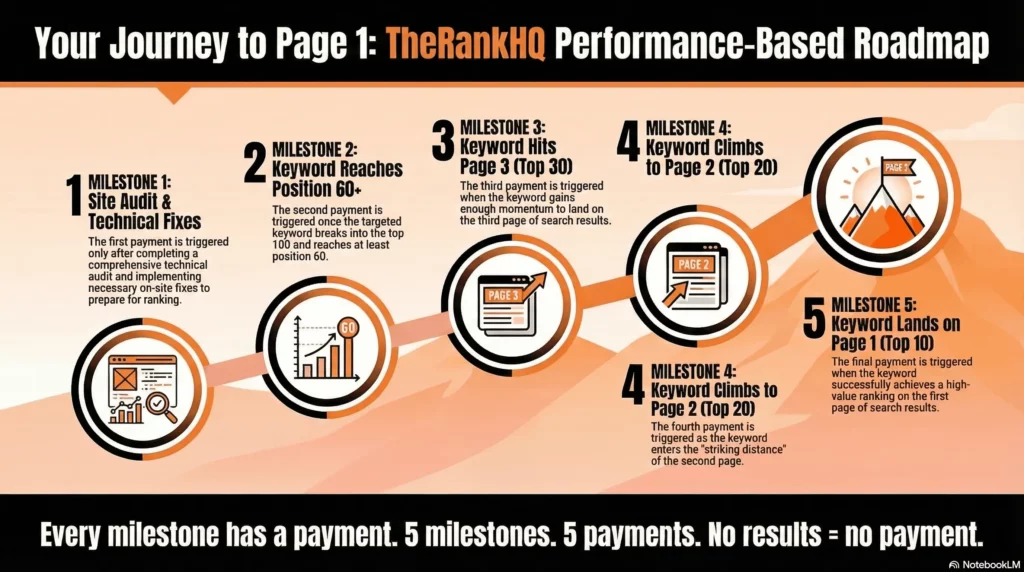
At TheRankHQ, this is Milestone 1. We fix the technical issues, optimize on-page elements (title tags, meta descriptions, content structure) and make sure Google can actually crawl and understand the site. Once the audit is complete and fixes are implemented, the first milestone payment is triggered.
Stage 2: Keyword Research and Target Agreement
This is where the contract gets specific. Both sides agree on exactly which keywords will be tracked, what starting positions look like, and what milestones will trigger payments.
And here’s where bad agencies get sneaky. They’ll pick keywords that are easy to rank for. Long-tail phrases with zero search volume. Then they hit “milestones” fast and collect payment. Meanwhile, your phone never rings.
A legitimate performance agency picks keywords that matter to your business. Terms your actual customers search for. Terms with real monthly volume and genuine commercial intent. If the agency can’t explain why each keyword was chosen and how it connects to your revenue, walk away.
Stage 3: On-Page Optimization and Content
With the technical foundation solid and keywords locked in, the focus shifts to content. Service pages get optimized. Blog content gets created to build topical depth around your target terms. Internal linking structures get built so Google understands how your pages relate to each other.
This stage is where the real SEO work lives. And it takes time. Google’s own documentation on their SEO Starter Guide makes this clear: there’s no shortcut to making content that search engines consider valuable.
Stage 4: Authority Building Through Links
Once the on-page work is solid, high-quality link building and outreach kicks in. This is what gives your site the credibility to compete for tougher keywords. Contextual backlinks from relevant, authoritative sites in your niche.
In our model, this is typically around Milestone 3. The target keyword has moved from the depths of page 8 to somewhere around page 3. The site has earned enough trust that link building can now push it further. This is where momentum starts compounding.
Stage 5: Milestone Payments Begin
Here’s where the model becomes tangible. Let me show you what a real milestone agreement looks like for a mid-competition keyword:
Milestone 1: Audit complete, technical fixes implemented. First payment triggered.
Milestone 2: Target keyword reaches position 60 or better. Second payment triggered.
Milestone 3: Keyword reaches page 3 (top 30). Third payment.
Milestone 4: Keyword climbs to page 2 (top 20). Fourth payment.
Milestone 5: Keyword lands on page 1 (top 10). Final milestone payment.
Each milestone has a defined payment amount agreed before any work begins. You can see exactly what you’re paying for and when. No ambiguity. No “trust us, we’re working on it.”
That’s TheRankHQ’s 5-Milestone Performance Model. It’s simple, it’s trackable, and it puts every dollar of your investment behind a verifiable result.
How It Differs From Traditional Retainer SEO
The retainer model is simple: you pay a flat monthly fee, and the agency works on your site. Month after month. Whether rankings move or not.
It’s like a gym membership. You pay every month whether you show up or not. Performance SEO is more like a personal trainer who only gets paid when you hit your fitness goals. Same destination. Very different motivation.
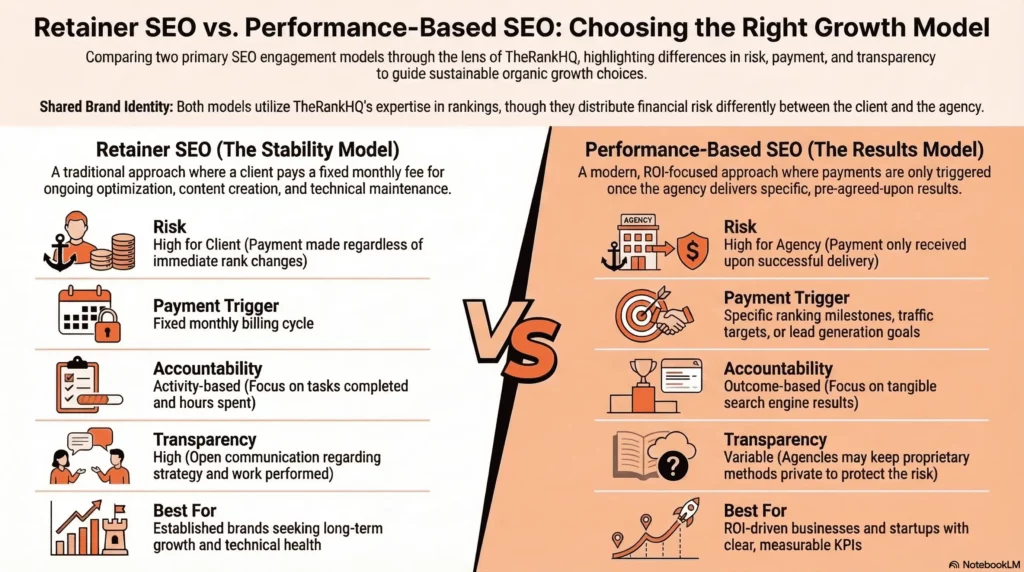
Here’s how the two models compare across five dimensions that actually matter:
| Criteria | Retainer SEO | Performance-Based SEO |
|---|---|---|
| Who carries the financial risk? | You. You pay regardless of outcomes. | The agency. They invest upfront and get paid on results. |
| What triggers payment? | Calendar date (1st of the month). | Measurable milestone (ranking, traffic, or leads). |
| How is accountability enforced? | Monthly reports (which may or may not mean anything). | Hard metrics tied directly to payment. |
| How transparent is the process? | Varies wildly. Some agencies are black boxes. | Must be transparent. The milestones require proof. |
| Is it better for long-term strategy? | Yes. Retainers support ongoing content and maintenance. | Depends. Works well for defined keyword targets. Less ideal for ongoing content engines. |
I want to be honest here. Retainer SEO isn’t bad. It works better for some situations.
If you’re an enterprise with thousands of pages needing continuous technical optimization and content updates, a retainer makes sense. There’s always work to do, and the scale justifies a flat monthly investment.
But if you’re a small-to-mid business that’s been paying $2,000 a month for six months with nothing to show for it? Performance-based SEO exists specifically for you. It forces accountability that the retainer model simply doesn’t.
The Real Risks of Performance-Based SEO
I’d be lying if I said this model is risk-free. It’s not. And I think the people who pretend otherwise are doing you a disservice.
Here’s the straight truth: the performance pricing structure can push bad agencies toward shortcuts. When your income depends on hitting ranking targets, there’s a temptation to hit those targets by any means necessary.
The low-quality keyword trick. Some agencies deliberately target obscure long-tail keywords with zero search volume. They rank fast, collect payment, and your phone never rings. Technically they “delivered results.” Practically, you got nothing of value.
Black hat tactics. Keyword stuffing. Private blog networks. Spammy link farms. Content spinning. These tactics can spike rankings in the short term. Long enough for an agency to hit a milestone and get paid. But Google catches up. And when it does, the penalties can tank your site for months or years.
Rankings-only tunnel vision. If the contract only measures keyword positions, the agency has no incentive to care about your traffic quality, conversion rate, or actual revenue. You end up with a page-1 ranking for a term that drives zero business.
Hidden fees. Some agencies advertise “no payment until results” but charge setup fees, audit fees, or “maintenance fees” on top. The performance model becomes a smokescreen for traditional billing with extra steps.
Google’s Search Quality Rater Guidelines emphasize that quality content requires genuine expertise, experience, authoritativeness, and trust. Those are the E-E-A-T signals. Any agency using shortcuts to game milestones is building on a foundation that violates these principles.
But here’s what I want you to take away: the model itself isn’t flawed. The execution is what matters. The risks I just described are risks of hiring the wrong agency, not risks inherent to the pricing structure.
What to Look for in a Legitimate Performance-Based Agency
So how do you tell the difference between a performance agency that’ll build your business and one that’ll destroy your site? Here are seven things I’d check before signing anything.
Do they start with a real audit? If the first thing an agency talks about is rankings, not your site’s current health, that’s a problem. Ethical agencies fix the foundation first. At TheRankHQ, Milestone 1 is the audit and technical fixes. You pay for real work from day one, and every milestone after that builds on a solid foundation.
Are the target keywords tied to your actual business? Ask them to explain why each keyword was selected. What’s the monthly search volume? What’s the commercial intent? If they can’t answer these questions clearly, they’re picking easy wins instead of valuable ones.
Can you see the milestone structure before signing? The pricing and payment triggers should be spelled out in writing. Every milestone, every payment amount, every keyword tracked. If it’s vague, it’s designed to be vague.
Do they show real case studies? Not testimonials. Case studies. With before-and-after data. Specific keywords, starting positions, ending positions, timelines. If possible, ask for references you can actually verify.
Will they explain their tactics openly? A legitimate agency will tell you exactly how they plan to move your rankings. Content creation. Technical fixes. Link building from real sites. If they won’t explain their methods, or get defensive when you ask, there’s a reason they’re hiding it.
Is there a clear exit clause? What happens if you want to stop? Do you keep the work that’s been done? Are there cancellation penalties? An agency confident in their work doesn’t need to lock you into restrictive contracts.
Do they track more than just rankings? This is the big one. The best performance agencies track rankings, organic traffic, conversion rates, and actual leads generated. Rankings without revenue are just expensive bragging rights.
Here’s a quick way to see the difference in practice. A red flag contract reads: “We will optimize 5 keywords for first-page rankings.” That’s it. No keyword selection criteria. No timeline. No methodology. No exit.
A green flag contract reads: “We will target these 5 specific keywords [listed with volume and intent data], with milestones at position 60, page 3, page 2, and page 1, using white-hat on-page optimization and editorial link building. Milestone payments of $X at each stage. Full reporting access via Google Search Console. 30-day exit clause after Milestone 2.”
Night and day. And you can tell the difference before you spend a dollar.
Learn more about our team and approach to understand how we structure these agreements in practice.
Performance SEO in the Age of AI Search
Here’s something none of the other guides about performance-based SEO are talking about: the metrics need to evolve.
In 2026, ranking on Google’s page 1 is no longer the only game in town. Your potential customers are asking ChatGPT for recommendations. They’re using Gemini to compare services. They’re getting answers from Perplexity that may or may not include your brand.
If your performance agreement only tracks Google rankings, you’re measuring half the picture.
At TheRankHQ, we’re seeing a shift in how forward-thinking businesses define “results.” Smart performance models now track what I call “share of model.” How often your brand gets cited by LLMs. We track that alongside traditional position tracking. This is the next evolution of pay-for-results.
Practically, this means your AI search optimization strategies need to run in parallel with traditional SEO. Structured data, entity optimization, citable content formats, E-E-A-T signals. These aren’t just Google factors anymore. They’re the same signals AI engines use to decide which brands to recommend.
When evaluating a performance-based SEO agency right now, in March 2026, ask them one question: “Are you tracking our visibility in AI search, or just Google?” If the answer is only Google, they’re already behind.
Who Should (and Shouldn’t) Choose Performance-Based SEO
This model isn’t for everyone. And I’d rather tell you that upfront than sell you something that doesn’t fit.
Performance-based SEO is a strong fit if:
You’re a small-to-mid business with clearly defined target keywords. Maybe you’re a dental practice wanting to rank for “dentist near me” or a local service company targeting specific geographic terms. The keywords are identifiable, the competition is assessable, and results can be measured in a reasonable timeframe.
You’ve been burned by retainer agencies before. You paid monthly fees for months with nothing to show. Performance pricing gives you the accountability that was missing.
Budget matters. You can’t justify $2,000-$3,000 a month on a gamble. You need to know every dollar connects to a measurable outcome.
Performance-based SEO isn’t ideal if:
You’re an enterprise site with 10,000+ pages that need continuous technical maintenance, content refreshes, and ongoing optimization. That kind of work doesn’t fit neatly into milestones. It’s genuinely ongoing.
Your industry is so competitive that realistic timelines stretch beyond 12 months. In ultra-competitive niches, the investment required before any milestone hits can strain the model for both sides.
You need a full-funnel content strategy, not just rankings. If your goal is building thought leadership, nurturing leads through a content funnel, and creating hundreds of blog posts, a retainer model gives the agency more flexibility to execute that vision.
The right pricing model depends on your situation. Not every problem is a nail, and performance SEO isn’t the only hammer.
The Bottom Line
Performance-based SEO isn’t magic. It’s a pricing model. And like any model, it works when it’s applied honestly and falls apart when it isn’t.
The mechanics are simple: find the right keywords, fix the technical foundation, build authority through quality content and links, and tie payments to measurable milestones. The hard part is finding an agency that does all of that without cutting corners.
If you want to see how a milestone-based model would work for your specific keywords and industry, check out our Pay-Per-Rank SEO service and request a free ranking audit. We’ll tell you straight whether performance pricing makes sense for your situation. And if it doesn’t, we’ll tell you that too.
Frequently Asked Questions
How long does performance-based SEO take to show results?
Most campaigns start showing measurable movement within 3-6 months, with early milestones (keyword reaching top 60) often hit in the first 2-3 months. Getting to page 1 typically takes 4-8 months depending on competition. SEO is a long-term strategy regardless of the pricing model. Anyone promising page 1 in 30 days is lying.
What happens if the agency doesn’t hit the milestones?
That’s the whole point of the model. You don’t pay. A legitimate performance agency absorbs that risk. If milestones aren’t hit, they’ve invested their own time and resources without compensation. This is exactly why ethical agencies do thorough research before accepting a client. They need to believe the milestones are achievable.
Can performance SEO hurt my website long-term?
Only if the agency uses black hat tactics. Keyword stuffing, spammy links, and content spinning can earn Google penalties that take months to recover from. That’s why vetting the agency’s methodology matters more than the pricing model itself. Ask how they build links. Ask to see their content. If anything feels automated or mass-produced, that’s your warning.
How much does performance-based SEO cost compared to retainers?
Traditional retainers typically run $1,000-$5,000 per month depending on scope and competition. Performance models vary widely, but a common structure is a small base fee ($300-$800/month) plus milestone payments ranging from $500-$2,000 per milestone hit. Total investment is often comparable. It’s just structured around results instead of calendar months.
Is performance-based SEO good for local businesses?
It’s one of the best fits, actually. Local businesses have clear, geographically targeted keywords (“plumber in Dallas,” “dentist in Brooklyn”) that are well-suited to milestone tracking. The competition is assessable, timelines are reasonable, and rankings translate directly to phone calls and foot traffic. If you’re a local business evaluating SEO for the first time, a performance model reduces your risk significantly.
