
GEO vs. SEO: How Search Optimization Is Changing in the Age of AI
Google still processes billions of searches daily. That hasn't changed. What has changed is where people go BEFORE they Google something. Or whether they Google it at all.
Google still processes billions of searches daily. That hasn't changed.
What has changed is where people go BEFORE they Google something. Or whether they Google it at all. Gartner predicts that traditional search engine volume will drop 25% by 2026 as AI chatbots and virtual agents absorb more of the discovery process. And that prediction is already playing out.
A Semrush study of over 10 million keywords found that Google's own AI Overviews doubled in just three months, jumping from 6.49% of queries in January 2025 to 13.14% by March 2025. That's Google itself replacing traditional results with AI-generated answers.
This doesn't mean SEO is dead. Far from it. But it does mean a new layer has been added on top. That layer is called GEO, or Generative Engine Optimization.
We've been building our generative engine optimization framework and testing it across client campaigns for over a year now. I want to break down what's genuinely different about GEO versus traditional SEO, where the two overlap (more than you'd expect), and what to focus on first depending on where your business stands today.
What Is SEO? (The Foundation You Already Know)
Search Engine Optimization is the practice of making your website visible in search engine results pages. You optimize so Google and Bing can crawl your content, understand what it's about, and rank it when someone searches for related terms.
The core mechanics haven't changed much over the years. Quality content, strong backlinks, clean technical health, and solid E-E-A-T signals (Experience, Expertise, Authoritativeness, Trust) still drive rankings.
Success in traditional search engine optimization is measured by things you can track clearly: keyword rankings, organic traffic volume, and click-through rates. You know where you stand because Google Search Console tells you.
I'm not going to spend 500 words explaining SEO basics. You probably already know this. What you might not know is how the newer model works, and where the real differences show up.
What Is GEO? (And Why It's Not Just "SEO With a New Name")
Generative Engine Optimization is the practice of structuring your content so AI platforms like ChatGPT, Gemini, Perplexity, and Google's AI Overviews cite it when generating answers to user queries. Instead of ranking on a results page, the goal is becoming the source AI trusts enough to reference.
Here's what actually happens behind the scenes. When someone types a question into ChatGPT or Perplexity, the AI engine doesn't just pull up a list of links. It retrieves relevant content from across the web, scores each source on relevance, authority, freshness, and structure, then synthesizes a new answer. If your content is clear and trustworthy enough, the AI cites you as a source.
That citation is the new visibility. As of early 2026, ChatGPT alone handles over 2 billion queries daily with more than 883 million monthly users. Those users aren't clicking through search results. They're reading AI-generated answers and trusting the sources those answers reference.
Now, I know what some of you are thinking. "This sounds like good SEO with a different label." And honestly? You're about 70% right.
As Google's Search Central documentation explains, "Google's systems aim to prioritize content that seems most helpful." That same principle applies to AI engines. High-quality content that ranks well on Google often gets cited by AI too. Research from multiple studies shows that seven of the top ten organic search results are also cited by Google's AI Overviews. The overlap is real.
But that 30% gap? That's where GEO lives. And ignoring it means leaving AI visibility on the table.
5 Things GEO Requires That Traditional SEO Doesn't
This is the section most articles on this topic skip. They say "GEO is different" but never explain what specific practices change. Here's what's genuinely new.
1. Passage-Level Optimization
In SEO, you optimize whole pages. Google evaluates your entire URL, considers its overall relevance, and ranks it accordingly.
GEO works differently. AI engines match user queries to specific paragraphs within your content, not to full pages. Each paragraph gets evaluated independently for whether it can answer part of the user's question.
This means every paragraph in a GEO-optimized article needs to be self-contained. It should open with a clear statement, convey a complete thought, and make sense even if someone reads it completely out of context.
Here's what this looks like in practice.
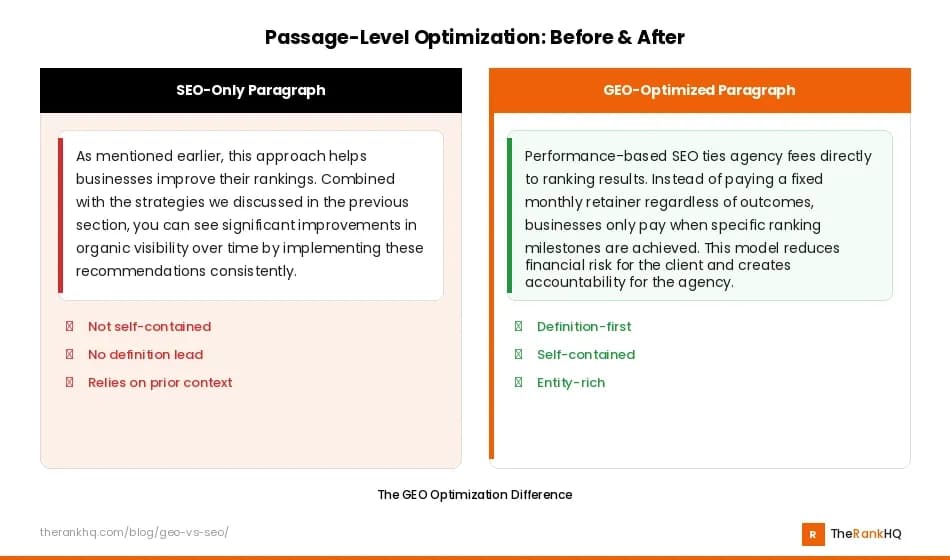
SEO-only paragraph: "As mentioned earlier, this approach helps businesses improve their rankings. Combined with the strategies we discussed in the previous section, you can see significant improvements in organic visibility over time by implementing these recommendations consistently."
GEO-optimized paragraph: "Performance-based SEO ties agency fees directly to ranking results. Instead of paying a fixed monthly retainer regardless of outcomes, businesses only pay when specific ranking milestones are achieved. This model reduces financial risk for the client and creates accountability for the agency."
See the difference? The first paragraph relies on context from previous sections. An AI engine extracting it would get nothing useful. The second paragraph defines the concept, explains the mechanism, and stands completely on its own as a citable answer.
2. Content Chunking
AI retrieval systems process content in chunks, typically between 40 and 120 words per extractable block. These chunks are what get fed into the language model for answer generation.
In SEO, a 3,000-word article works as a single unit. Length can even help because Google sees topical depth. But for GEO, that same article needs to be built from modular blocks where each section functions as an independent answer to a potential question.
I would suggest thinking of your content like building with LEGO bricks. Each brick (paragraph or short section) should snap together to build the full article, but also work perfectly fine as a standalone piece.
3. Query Fan-Out (How AI Searches Differently)
When you type "best SEO strategy for small business" into Google, the engine matches that phrase against indexed pages.
When you type a 23-word prompt into ChatGPT, something completely different happens. The model breaks your prompt apart into multiple sub-queries (a process called "query fan-out"), searches for content relevant to each sub-query independently, then combines the results into one answer.
According to research from XFunnel, the average AI search prompt is 23 words long, compared to the 2-3 word queries typical in traditional search. This means your content needs to cover related sub-topics within each article, not just the primary keyword. If a user asks about GEO strategy and the AI fan-out includes sub-queries about measurement, tools, and implementation, your content needs to touch all of those to get cited.
4. Off-Site Reputation Carries More Weight
Traditional SEO focuses almost entirely on your website. Your pages, your backlinks, your technical health.
GEO extends far beyond that. AI engines pull information from Reddit threads, Quora answers, industry forums, news articles, reviews, and third-party mentions. All of these shape how AI models understand and describe your brand.
Here's the part most people miss: a negative Reddit thread about your company can influence how ChatGPT answers questions about your industry. Even if your website content is perfect. You can't control this the same way you control on-page SEO, which makes active reputation management across these platforms a GEO necessity, not just a PR nice-to-have.
5. No Stable Rankings
In SEO, you can open Google Search Console and see that you rank #4 for a specific keyword. That position might fluctuate, but it's trackable and relatively stable.
GEO doesn't work that way. Large language models are probabilistic, not deterministic. The same prompt can produce different answers on different days, citing different sources depending on the model version, conversation context, and what content the retrieval system pulls in real time.
This makes measurement harder. But it also creates opportunity. Unlike SEO, where top positions can feel locked in by high-authority sites, AI citations are more fluid. A smaller brand with excellent, well-structured content can break through in ways that are much harder on Google's entrenched first page.
Where GEO and SEO Overlap (What You're Already Doing Right)
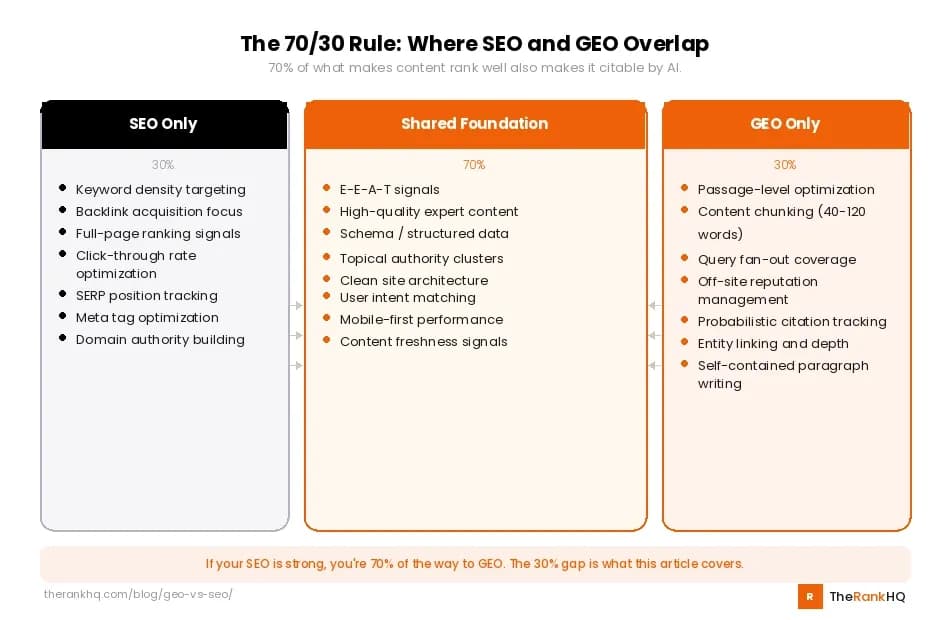
Before you panic about rebuilding your content strategy from scratch, let me be clear: if you're doing strong SEO work today, you've already built most of what GEO requires.
Both systems reward high-quality, expert content. Both prioritize E-E-A-T signals. Both benefit from structured data, clean schema markup, and clear site architecture. Building topical authority through content clusters helps your Google rankings AND makes you more likely to get cited by AI.
As Google's own documentation on ranking systems makes clear, their systems work to surface the most reliable and helpful information possible. That's true whether the content is being surfaced in a blue link or inside an AI-generated summary.
Think of it like fitness and nutrition. They share the same goal (better health) and overlap in many ways (both need consistency, both benefit from planning). But optimizing your workout routine doesn't automatically fix your diet. You need deliberate effort on each.
The same applies here. Strong AI search optimization strategy builds on solid SEO. But it adds specific practices, like passage-level optimization and off-site reputation management, that SEO alone doesn't cover.
If your current SEO game is strong, you're already about 70% of the way there. The question is whether you're doing the other 30% deliberately.
GEO vs. SEO: Side-by-Side Comparison
Here's everything in one view. Bookmark this table.
DimensionSEOGEO
Goal
Rank in search results
Get cited in AI-generated answers
Target Platforms
Google, Bing
ChatGPT, Perplexity, Gemini, Google AI Overviews
Content Focus
Keywords + topical depth across full pages
Self-contained passages + entity-rich depth
Success Metrics
Rankings, organic traffic, CTR
AI citations, brand mentions, share of model
Technical Priorities
Site speed, crawlability, backlinks
Passage optimization, schema, entity linking, freshness
Optimization Scope
Your website (primarily)
Your website + third-party mentions, forums, reviews
Time to Impact
3-6 months typically
Variable, depends on model updates and existing authority
Measurement
Google Search Console, Ahrefs, Semrush
Manual prompt testing + emerging AI visibility tools
How to Check Your Visibility in Both Worlds
Most businesses have no idea whether AI engines even know they exist. Here's a quick audit you can run in 20 minutes.
Check your SEO visibility first. Open Google Search Console. Go to Performance. Look at your impressions, average position, and click-through rate for your target keywords. If your core pages aren't getting impressions at all, your foundation needs work before GEO makes sense.
For deeper analysis, run your domain through Ahrefs Site Explorer. Click "Organic Keywords" and filter by Position 8-20. These are your striking-distance opportunities where a content refresh or technical SEO audit could push you onto page one.
Now check your GEO visibility. Open ChatGPT, Perplexity, and Gemini in three browser tabs. Type the questions your customers actually ask. Not keywords like "dental SEO services." Full conversational prompts like "What's the best way to improve my dental practice's visibility on Google?"
Read the AI responses carefully. Is your brand mentioned? Are competitors getting cited instead? Screenshot the results and save them as your baseline.
For tracking at scale, tools like Semrush's AI Visibility Toolkit and HubSpot's AI Search Grader can monitor your brand's presence across AI platforms. These tools are still maturing, but they're the best options available right now.
If you need a more detailed walkthrough, our AI search readiness checklist covers the full audit process step by step.
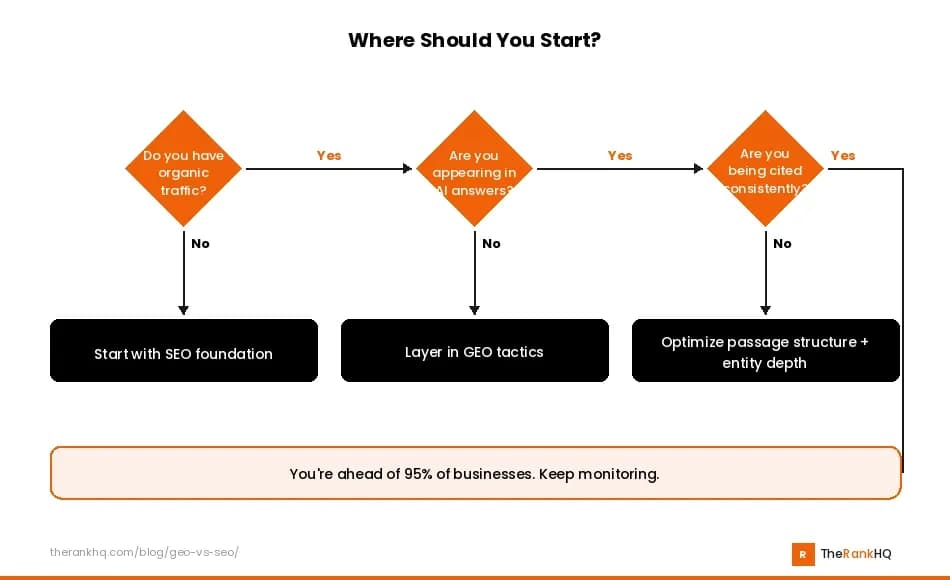
The quick diagnostic: If you show up in Google results but not in AI answers, your content has an SEO foundation but needs GEO optimization. If you're invisible in both, start with SEO first.
What About AEO (Answer Engine Optimization)?
You might have come across another term in this space: AEO, or Answer Engine Optimization.
Answer Engine Optimization is the practice of structuring content to appear as direct answers in features like Google's featured snippets, People Also Ask boxes, and voice search results. It actually predates GEO. The concept started with optimizing for featured snippets years before ChatGPT existed.
So how does it relate to GEO and SEO?
Some industry experts, like those at Conductor and Amsive, treat AEO as a subset of GEO. Others use the terms interchangeably. The truth is that the industry hasn't standardized the terminology yet. As one SEO expert put it, "the acronym doesn't really matter as long as you understand you are optimizing content for AI search as well."
Here's the practical distinction. If you're winning featured snippets consistently, you're already doing AEO. The step from AEO to full GEO involves passage-level content restructuring, active entity optimization, and managing your reputation across platforms that AI engines pull from.
The key to getting cited by ChatGPT and other generative models goes beyond just answering questions concisely. It requires building the kind of authority and content structure that AI retrieval systems trust.
Don't get hung up on the acronyms. Focus on the practices.
What to Prioritize First (Based on Where You Are Now)
Every article on this topic says "do both SEO and GEO." And that's technically correct. But it's not helpful when you have limited time and budget.
Here's what I would suggest based on where your business stands today.
If you have little or no organic traffic, start with SEO. Without indexation and basic rankings, GEO has nothing to build on. AI engines pull heavily from content that already performs well in traditional search. Build your foundation first.
If you rank well but AI engines ignore you, layer in GEO tactics. Restructure your existing content with self-contained paragraphs. Add entity depth. Build FAQ sections with clear, extractable answers. Start engaging on forums and platforms where your customers ask questions.
If you're building a brand from scratch, do both simultaneously. Structure every piece of content for passage-level extraction from day one. It costs nothing extra at the content creation stage, and it means you won't have to retrofit everything later.
We've seen this pattern across client campaigns. Businesses that build GEO practices into their content workflow from the start see AI citations appear significantly faster than those who try to optimize existing SEO content after the fact. The structure is harder to add retroactively.
And if you want the data to back the urgency: Gartner predicts traditional search volume will drop 25% by 2026 as AI takes over more of the discovery process. Meanwhile, AI Overviews doubled in market presence within a single quarter. That trajectory isn't slowing down. The businesses building for both traditional and AI search right now are going to own the discovery landscape. The ones waiting for the industry to "figure it out" will be playing catch-up.
Frequently Asked Questions
Is GEO going to replace SEO?
No. Google still drives over 200 times more traffic to websites than AI platforms combined. SEO remains the foundation of online visibility.
But GEO is becoming essential as more queries get answered directly by AI. The smart approach is building both, not choosing between them.
Is AEO the same as GEO?
They're closely related. AEO started with optimizing for featured snippets and voice search. GEO evolved from that to cover AI-generated responses from platforms like ChatGPT and Perplexity.
Some experts use the terms interchangeably. What matters isn't the label but the practice: making your content clear, structured, and authoritative enough for any AI system to cite.
Can small businesses compete with large brands in GEO?
Yes, and this is one of the most exciting things about GEO. AI engines don't always pick the biggest brand. They pick the clearest, most structured, most authoritative content for a specific topic.
A small dental practice with excellent locally focused content can get cited over a national chain. A niche B2B consultant can appear in ChatGPT's answers ahead of a Fortune 500 competitor. Content quality and structure matter more than brand size in AI citations.
How do I measure GEO success?
The measurement landscape is still developing. Right now, the most practical approach is manual prompt testing. Ask AI tools the questions your customers ask and check if your brand appears.
Semrush's AI Visibility Toolkit and HubSpot's AI Search Grader offer more scalable tracking. But manual testing gives the most accurate real-time picture of how AI models are actually using your content.
Do I need separate content for SEO and GEO?
No. The best approach is creating content that works for both at once.
Write every paragraph as a self-contained, definition-first block. Use clear headings, structured data, and entity-rich language. This structure serves Google's crawlers AND AI retrieval systems simultaneously. One content investment, two discovery channels.
The Bottom Line
The future of search isn't SEO or GEO. It's both, built deliberately as layers.
SEO gets you discovered. GEO gets you cited. Together, they cover the full discovery landscape that your customers are using right now.
If your SEO foundation is solid, start layering in GEO today. If it's not, fix the foundation first. Either way, the direction is clear: AI-driven discovery is growing fast, and the brands building for both worlds are the ones that will own the next era of search visibility.
If you're looking for a results-driven SEO approach that builds both traditional rankings and AI citation readiness, that's exactly what we do at TheRankHQ.
Keep reading

- SEO
How Performance-Based SEO Pricing Works: Milestones, Metrics & Payment Structures
Learn how performance-based SEO pricing actually works. Compare per-keyword, per-lead, and milestone models with real costs, red flags, and verification steps.
- SEO
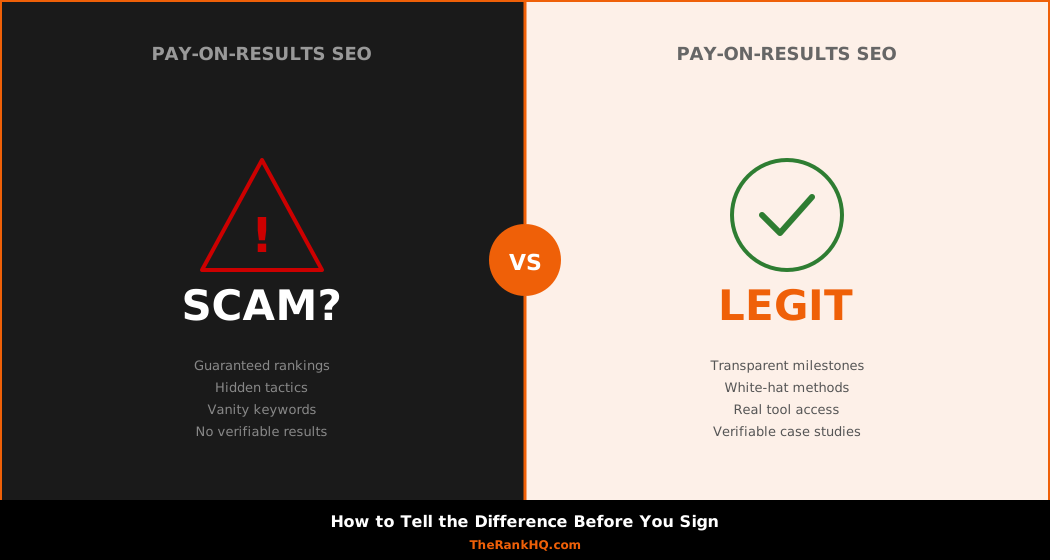
Is Pay-on-Results SEO Legit? How to Spot Scams vs. Real Agencies
You’ve heard the pitch before. “Pay us $2,000 a month, and we’ll optimize your site.” Six months later, your rankings haven’t moved, but the invoices kept coming.
- SEO
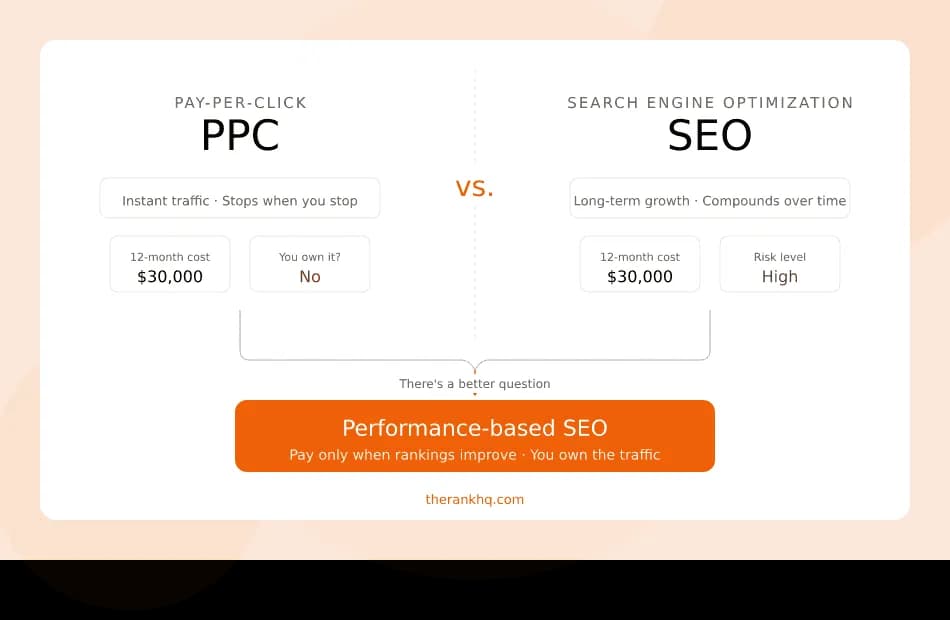
PPC vs. SEO: Which Delivers Better ROI (And Why Performance-Based SEO Changes the Equation)
PPC gives instant traffic. SEO builds long-term growth. But performance-based SEO eliminates the risk of both. See the 12-month cost breakdown.