
How Performance-Based SEO Pricing Works: Milestones, Metrics & Payment Structures
Learn how performance-based SEO pricing actually works. Compare per-keyword, per-lead, and milestone models with real costs, red flags, and verification steps.

Most business owners understand pay-for-performance SEO in about 30 seconds. You rank, you pay. You don't rank, you don't pay.
Simple enough on the surface.
The confusion starts when it's time to sign the contract. What exactly triggers a payment? What is the agency doing between milestones? And if three different pricing models all call themselves "performance-based," which one is actually transparent, and which one is designed to extract money from you before real results show up?
I've run our milestone-based SEO model across 30+ client campaigns. I've seen all three pricing structures from the inside, and I can tell you that the label "performance-based" hides more than it reveals.
This guide breaks down the exact mechanics of each model so you can evaluate any agency's pricing with your eyes wide open.
What "Performance-Based SEO Pricing" Actually Means
Performance-based SEO pricing is any model where your payment is tied to measurable SEO outcomes rather than time spent working on your site. You don't pay for effort. You pay for movement.
Think of it like hiring a real estate agent versus a salaried employee to sell your house. The salaried employee gets paid whether the house sells or not. The agent only earns their commission when the deal closes.
Performance SEO works the same way: the agency's revenue depends on producing results you can verify.
According to SE Ranking's 2025 SEO agency pricing survey, 53% of agencies still prefer monthly retainers. Only a small fraction have moved to pure performance models.
That tells you two things. Most agencies aren't willing to stake their revenue on outcomes. The ones who are have either built a process they trust deeply, or they've found ways to game the system.
As Google's Search Central documentation states, "No one can guarantee a #1 ranking on Google." That's not a disclaimer. That's reality. Any pricing model that pretends otherwise is selling you a fantasy.
The Three Pricing Models (And Why They're Not Created Equal)
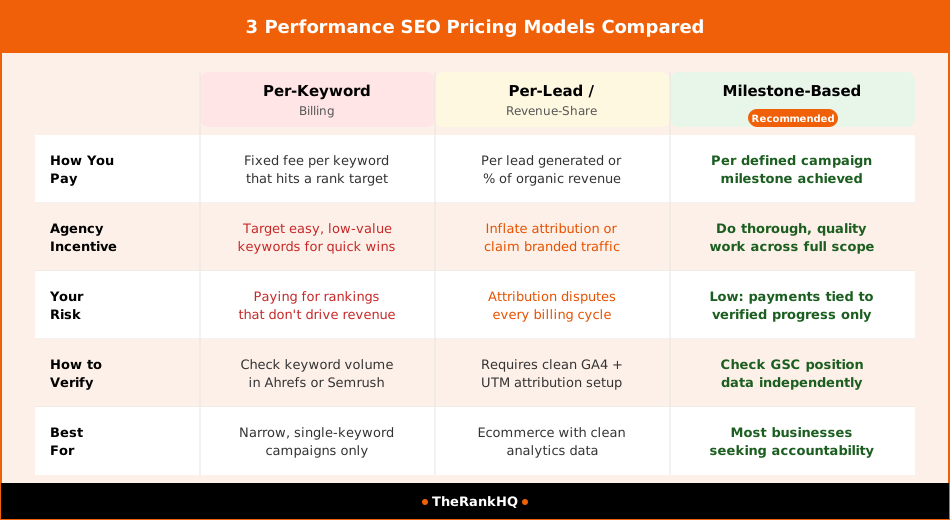
Not all performance SEO pricing is the same. The differences between these three structures determine whether you're paying for genuine progress or getting charged for vanity metrics that don't move your business.
Model 1: Per-Keyword Billing
This is the most common variant. You pick keywords, the agency works on them, and you pay a fee once each keyword hits a specific ranking position. Top 3 might cost $500. Top 10 might cost $200. Sounds logical.
Here's the problem. The agency gets paid fastest by ranking keywords that are easy to win. A keyword like "artisan handcrafted mahogany desk restoration services in north Portland" might be a zero-competition term with 5 monthly searches. The agency ranks it in two weeks, invoices you, and your phone never rings.
To check whether an agency is doing this, open Ahrefs. Go to Keywords Explorer. Type in the keywords they're proposing. Look at two numbers: Search Volume and Keyword Difficulty (KD). If the volume is under 50 and the KD is under 10, that keyword exists for their invoice, not your revenue.
Model 2: Per-Lead or Revenue-Share
Instead of ranking positions, payment is tied to leads or revenue generated from organic search. Better alignment with business outcomes, but attribution gets messy fast.
Did that form submission come from the blog post the SEO team optimized, or from a branded search the customer would have done anyway? Without a clean UTM tagging setup and proper Google Analytics 4 configuration, you'll argue about attribution every billing cycle.
I'm not a fan of this model for most small businesses. The tracking requirements are complex, and the room for disagreement is wide. It works better for ecommerce with clear purchase funnels and clean data.
Model 3: Milestone-Based Pricing
This is the model we use at TheRankHQ. Instead of billing per keyword or per lead, the entire campaign is broken into defined milestones. Each milestone represents a verifiable stage of progress, and each one triggers a payment.
Think of it like building a house. You don't pay the full amount before the first brick is laid. You pay when the foundation is done, when the walls go up, when the roof is on, when you get the keys. Each payment is tied to something you can see and inspect.
The difference from per-keyword billing is important. Milestone pricing rewards the agency for doing the full scope of work (technical fixes, content, link building, on-page optimization) rather than gaming individual keyword positions. The incentive is to build a strong, durable campaign, not to chase easy wins for quick invoices.
How Milestone-Based Pricing Works (Step by Step)
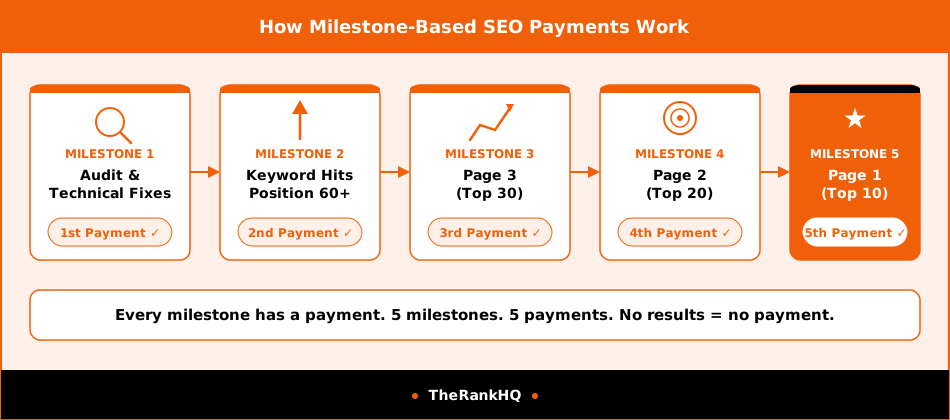
Let me walk you through exactly what happens at each stage. No vague "we'll optimize your site" descriptions. Actual steps you can verify.
Milestone 1: Audit and Technical Fixes
Nothing moves until someone looks under the hood. Before any content is written or any links are built, a proper technical SEO audit identifies what's broken. Crawl errors, indexation gaps, slow page speed, missing schema markup, broken internal links, duplicate content issues.
If an agency skips this step and jumps straight to "building links," that's your first red flag. You can't build rankings on a cracked foundation. At TheRankHQ, this is Milestone 1: audit complete, technical issues fixed, on-page elements optimized. First payment triggered.
To verify this yourself, open Google Search Console. Go to Pages > "Why pages aren't indexed." If the agency hasn't reduced the number of errors here, the audit work isn't done.
Milestone 2: Keyword Reaches Position 60+
This is where early traction becomes visible. The target keyword moves from buried on page 8 or 9 into the top 60 results. It's not traffic territory yet, but it tells you Google is recognizing the relevance signals.
Second payment triggered. Verifiable in Google Search Console under Performance > Search Results. Filter by query, check the average position.
Milestone 3: Page 3 (Top 30)
Now we're getting somewhere. The keyword has cracked the top 30. Quality link building and outreach is typically in full swing at this stage. Content is being built to establish topical depth. Internal linking structures are connecting related pages so Google understands how the site's content fits together.
Third payment. Again, verifiable independently through GSC.
Milestone 4: Page 2 (Top 20)
The keyword is now visible to searchers who scroll past the first page. This is often where the most intense competition sits, because the jump from page 2 to page 1 is where the real traffic difference lives.
According to Backlinko's search traffic study, pages on position 1 get roughly 27.6% of all clicks. By position 10, that drops to about 2.4%. And page 2? Almost nothing. This milestone is about building the authority needed to break through that final barrier.
Fourth payment triggered.
Milestone 5: Page 1 (Top 10)
The target keyword reaches Google's first page. Maximum visibility. Organic traffic begins flowing. This is where the real business impact starts.
Fifth and final milestone payment.
The beauty of this structure is simple. If the campaign stalls at Milestone 3, you've only paid for three milestones of verified progress. You've never paid for work that didn't produce results.
What Determines the Price of Each Milestone?
Not every performance SEO campaign costs the same. The price depends on several concrete factors, and understanding them helps you evaluate whether an agency's quote is reasonable or inflated.
Keyword competition is the biggest factor. Ranking a local plumber in a mid-sized city is a fundamentally different job than ranking a national ecommerce brand for "best running shoes." In Semrush, you can check the Keyword Difficulty score for any term. A KD of 15 requires different resources than a KD of 65.
Your site's current authority plays a role too. A domain that's been around for five years with existing backlinks has a head start. A brand new site needs more foundational work before rankings can move.
Industry and niche affects pricing because some verticals have more aggressive competitors. Finance, legal, and healthcare are notoriously difficult. Local services in smaller markets are usually more achievable.
Number of keywords matters. Targeting 3 keywords requires different scope than targeting 15. More keywords mean more content, more links, and more monitoring.
As Backlinko's SEO pricing data shows, the average monthly SEO retainer sits between $1,000 and $2,500 for most businesses. A milestone-based model often starts with a lower effective monthly cost, with the balance shifting toward milestone payments as results materialize.
How to Verify What You're Actually Paying For
Here's something most SEO pricing guides skip entirely. They tell you what to pay, but not how to confirm you're getting what you paid for.
I think this is the most important skill any business owner can develop when working with an SEO agency, regardless of pricing model. And it takes about 10 minutes per month.
Step 1: Check Google Search Console yourself. Go to Performance > Search Results. Filter by the keywords in your agreement. Look at the Position column. Is it moving down (improving)? Compare the last 28 days to the previous period. This is the same data the agency sees. If their reports don't match what you see here, ask why.
Step 2: Run a spot check in Ahrefs or Semrush. Go to Site Explorer. Enter your domain. Click "Organic Keywords." Sort by position. Are the target keywords showing up where the agency says they are? If you don't have an Ahrefs subscription, the free version of Ahrefs Webmaster Tools gives you enough data to verify.
Step 3: Check what the agency actually built. In Google Search Console, go to Links > External Links. Are new backlinks appearing from relevant, real websites? Or are they from spammy directories nobody visits? The quality of links tells you everything about the quality of the agency's work.
As Google's documentation on evaluating SEO providers warns: "Be careful if a company is secretive or won't clearly explain what they intend to do." If your agency can't show you exactly where your milestone payment went, that's a problem.
Red Flags in Performance SEO Contracts
Before you sign anything, look for these specific contract elements. They tell you whether the agency is legitimate or playing games.
Keyword selection should be collaborative. If the contract lets the agency choose all target keywords without your input, they'll pick easy wins that don't drive business. You should approve every keyword based on its relevance to your revenue, not just its search volume.
White-hat methodology should be in writing. The contract should explicitly state that the agency uses only Google-compliant strategies. If the word "ethical" or "white-hat" doesn't appear anywhere, ask why. And check their existing clients' backlink profiles in Ahrefs to see what kind of links they actually build.
You should have independent reporting access. A legitimate agency gives you direct access to Google Search Console and either Ahrefs or Semrush dashboards. If they only show you their own branded reports with no way to verify the data independently, that's a problem.
Post-ranking maintenance should be addressed. What happens after you hit page 1? Do you keep paying the same milestone rate? Is there a reduced maintenance fee? Rankings don't hold themselves. If the contract doesn't address post-milestone maintenance, you'll either lose your rankings or get hit with surprise charges.
Penalty liability should be clear. If the agency's work causes a Google penalty, who pays for recovery? This should be explicitly stated. At TheRankHQ, we use only white-hat methods. But if you're evaluating other agencies, this clause separates the confident from the careless.
The AI Search Factor Most Pricing Guides Ignore
Here's something I think most guides get wrong in 2026. They only talk about Google rankings. But the search world has changed.
If your performance agreement doesn't account for AI search visibility alongside Google rankings, you're measuring an incomplete picture. How often does ChatGPT mention your brand when someone asks about your industry? Does Gemini recommend your services? Does Perplexity cite your content?
We've started tracking what we call "share of model" for our clients. It's a measure of how frequently your brand appears in AI-generated answers across ChatGPT, Gemini, and Perplexity. This isn't a replacement for Google rankings. It's an additional dimension that smart performance models are beginning to include.
If two agencies both offer milestone-based pricing but only one tracks AI citation alongside traditional rankings, that's a meaningful difference in what you're actually getting for your money.
Frequently Asked Questions
How long does performance-based SEO take to show results?
Most campaigns show measurable movement within 3 to 6 months. Early milestones (keyword reaching top 60) often get hit in the first 2 to 3 months.
Getting to page 1 typically takes 4 to 8 months depending on competition. Anyone promising page 1 in 30 days is either targeting keywords nobody searches for, or planning to use tactics that will hurt you later.
What happens if the agency doesn't hit the milestones?
You don't pay. That's the entire point.
A legitimate performance agency absorbs that risk. If milestones aren't hit, they've invested their own time and resources without compensation. This is why ethical agencies do thorough research before accepting a client. They need to believe the milestones are achievable.
Can performance SEO hurt my website long-term?
Only if the agency uses black-hat tactics. Keyword stuffing, spammy links, and content spinning can earn Google penalties that take months to recover from.
That's why vetting the agency's methodology matters more than the pricing model itself. Ask how they build links. Ask to see their content quality. Check their track record with past clients.
How much does performance-based SEO cost compared to retainers?
Traditional retainers typically run $1,000 to $5,000 per month depending on scope and competition. Performance models vary widely, but a common structure is a small base fee ($300 to $800 per month) plus milestone payments ranging from $500 to $2,000 per milestone hit.
Total investment is often comparable. It's just structured around results instead of calendar months.
Is performance-based SEO good for local businesses?
It's one of the best fits. Local businesses have clear, geographically targeted keywords that are well suited to milestone tracking.
A dentist in Denver targeting "dental implants Denver" is a straightforward campaign to structure with milestones. The keyword has clear commercial intent, measurable competition, and directly connects to patient bookings.
What if I want to switch pricing models mid-campaign?
Most reputable agencies will work with you on this. If you started with milestones and want to transition to a retainer for ongoing maintenance after hitting page 1, that's a normal conversation.
The key is having it addressed in your original contract. Ask about model flexibility before you sign, not after.
The Bottom Line
Performance-based SEO pricing isn't one thing. It's three very different models wearing the same label. Per-keyword billing rewards gaming. Revenue-share creates attribution headaches. Milestone-based pricing aligns incentives around doing the actual work.
The pricing model you choose matters less than the agency behind it. Look at the contract details. Verify the keyword selection process. Demand independent reporting access. And make sure the agency is accounting for where search is heading in 2026, not just where it was in 2020.
If you want to see what a milestone-based engagement looks like with full transparency, explore how our performance SEO model works and compare it against any other agency's proposal. The details will tell you everything.
Keep reading
- SEO
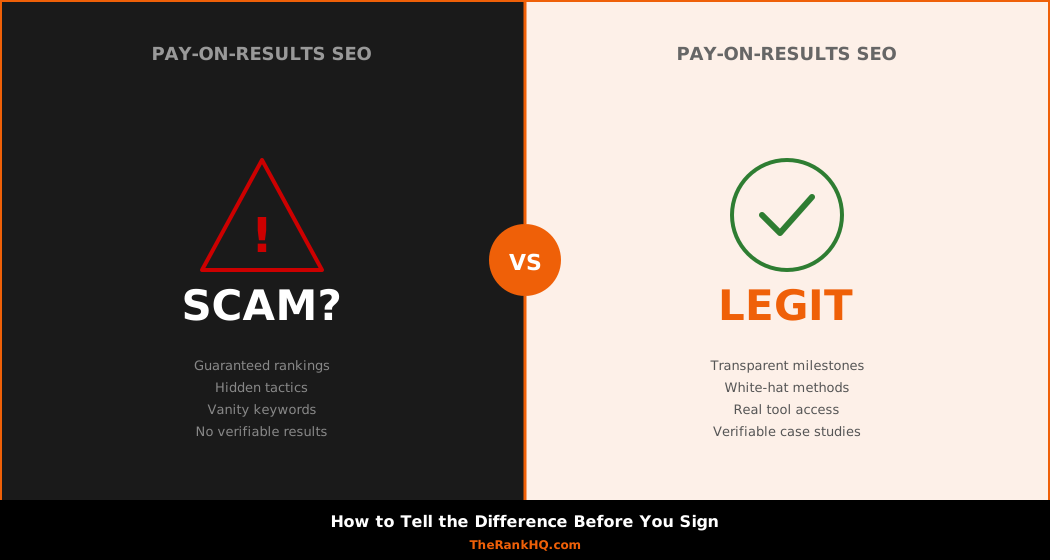
Is Pay-on-Results SEO Legit? How to Spot Scams vs. Real Agencies
You’ve heard the pitch before. “Pay us $2,000 a month, and we’ll optimize your site.” Six months later, your rankings haven’t moved, but the invoices kept coming.
- SEO
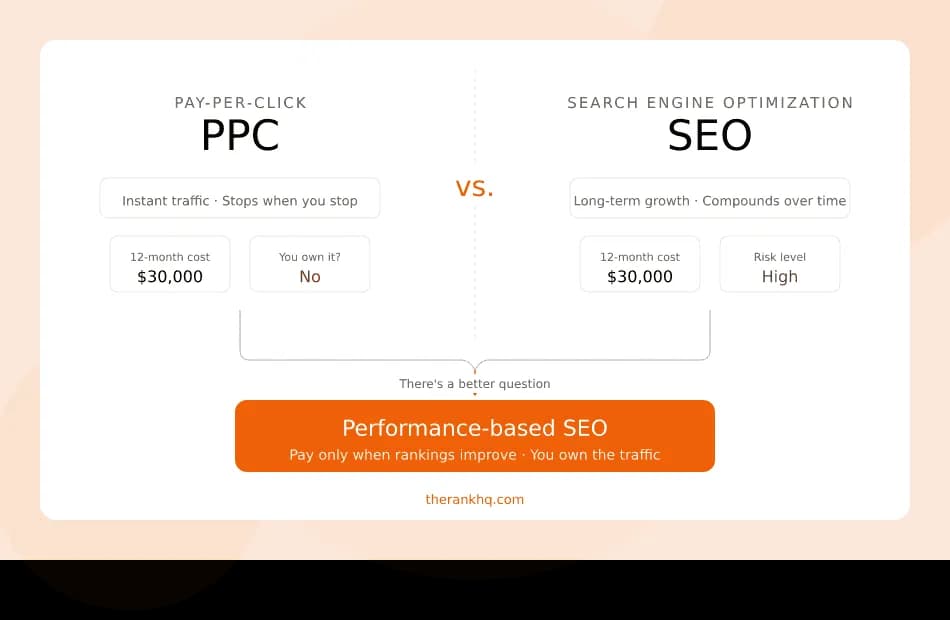
PPC vs. SEO: Which Delivers Better ROI (And Why Performance-Based SEO Changes the Equation)
PPC gives instant traffic. SEO builds long-term growth. But performance-based SEO eliminates the risk of both. See the 12-month cost breakdown.
- SEO
- AI SEO
GEO vs. SEO: How Search Optimization Is Changing in the Age of AI
Google still processes billions of searches daily. That hasn't changed. What has changed is where people go BEFORE they Google something. Or whether they Google it at all.