
Is Pay-on-Results SEO Legit? How to Spot Scams vs. Real Agencies
You’ve heard the pitch before. “Pay us $2,000 a month, and we’ll optimize your site.” Six months later, your rankings haven’t moved, but the invoices kept coming.
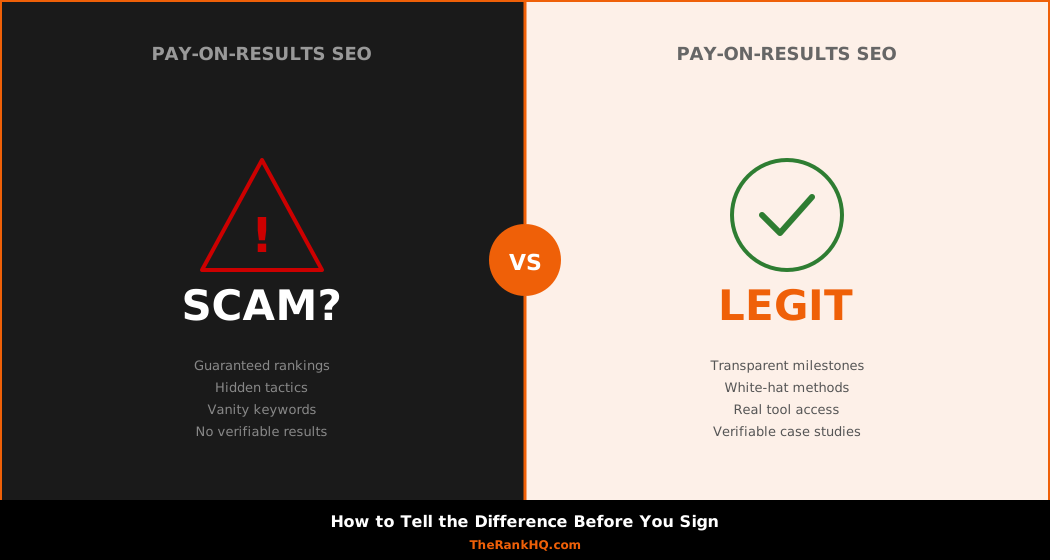
You've heard the pitch before. "Pay us $2,000 a month, and we'll optimize your site." Six months later, your rankings haven't moved, but the invoices kept coming.
So when you see an agency saying "pay only when you rank," it sounds like exactly what you've been looking for. Maybe too exactly.
Here's the reality. Performance-based SEO is a legitimate pricing model used by roughly 6% of SEO agencies, according to SE Ranking's 2025 industry pricing survey. The other 94% charge retainers regardless of results. That means the agencies willing to tie their revenue to your outcomes are either very confident in their process or very good at gaming the system.
This article helps you figure out which one you're looking at. You'll get specific red flags, contract clauses to demand, and a step-by-step way to verify an agency's claims before you hand over a dollar.
What "Pay-on-Results SEO" Actually Means (And Why There's More Than One Version)
Pay-on-results SEO is any pricing model where you pay after specific, measurable outcomes happen. Not before. That's the basic idea. But inside that umbrella, there are three very different structures, and confusing them is where most people get burned.
Per-keyword billing is the most common variant. You pick a keyword, the agency works on it, and you pay a set fee once it hits a certain ranking position. The top 3 might cost $500. The top 5 might cost $300. Sounds straightforward, right? The problem is the incentive structure. The agency gets paid faster by targeting keywords that are easy to rank for. Not keywords that actually bring you customers.
Per-lead models charge you for every lead that comes through organic search. Better alignment with business outcomes, but harder to attribute accurately. Did that lead come from SEO work or from a branded search they would have done anyway?
Milestone-based pricing works differently. Instead of paying per keyword or per lead, you pay when the agency hits defined project milestones. Think of it like hiring a contractor to build a house. You don't pay the full amount up front. You pay when the foundation is done, when the framing is complete, and when the roof goes on. Each milestone is verifiable and tied to real progress.
This is the model our pay-per-rank SEO service uses. Five milestones from audit through page 1 ranking. You can see exactly where your campaign stands at any point.
The distinction between these three matters is more than most articles admit. Per-keyword billing creates a system where the agency profits from gaming easy keywords. Milestone-based pricing creates a system where the agency only profits by doing the actual work. Same category. Very different incentives.
Why Performance-Based SEO Has a Reputation Problem (And What Caused It)
Let's be honest. Performance-based SEO has attracted some genuinely bad actors over the years. And the skepticism you're feeling right now? It's earned.
The pattern looks like this. An agency promises fast rankings. They use shady techniques like private blog networks, spammy link schemes, or keyword stuffing to push your site up quickly. You pay them when the rankings hit. Three months later, Google's algorithm catches up, your site gets penalized, and you're worse off than when you started.
Google's own documentation on hiring SEO professionals is blunt about this. As Google Search Central states, "No one can guarantee a first-page ranking." They go further, warning that practices violating their spam policies "may result in a negative adjustment of your site's presence in Google, or even the removal of your site from our index."
That's not a slap on the wrist. That's your site disappearing from search results entirely.
And here's what makes it worse. Recovering from a Google penalty often costs more than doing SEO properly in the first place. We've seen businesses spend 3 to 6 months undoing damage from a single bad agency engagement, which means lost revenue, lost rankings, and paying a second agency to fix what the first one broke. A proper technical SEO audit is usually the first step in recovery, and it's not cheap or quick.
But here's the nuance most anti-PFP articles won't tell you. These risks aren't exclusive to performance-based agencies. Retainer agencies can and do use the exact same black-hat tactics. The pricing model isn't the problem. The agency behind it is.
7 Red Flags That Expose a Scam Performance SEO Agency
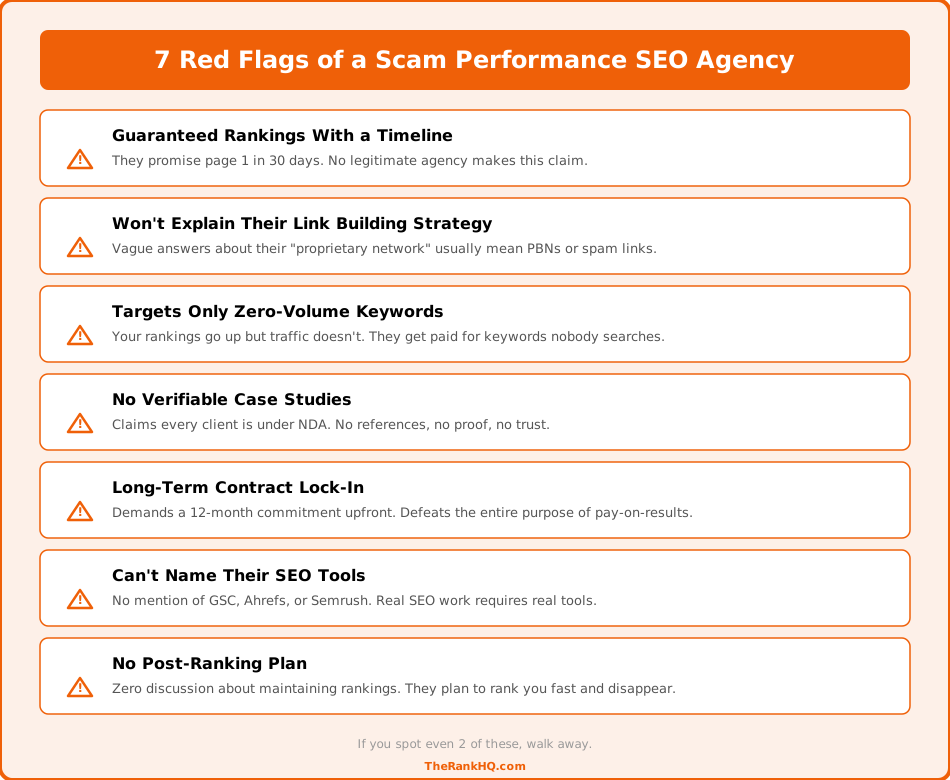
I've been in this industry long enough to recognize the warning signs within the first call. Here's what to watch for.
1. They guarantee page 1 rankings with a specific timeline.
No legitimate SEO professional makes this promise. Not because page 1 is impossible, but because timelines depend on your industry, competition, current site health, and Google's own algorithm behavior. When someone says "page 1 in 30 days," they're either lying or planning to use tactics that will hurt you long-term.
A real agency says, "Based on your competition and current authority, here's a realistic range for when you should see movement." That's honest. Specific timelines aren't.
2. They won't explain their link-building strategy.
Ask directly: "How will you build links to my site?" If the answer is vague ("we have a proprietary network") or they dodge the question entirely, walk away. Legitimate agencies using ethical link building strategies will tell you exactly what they're doing. Guest posts on relevant sites. Digital PR. Content-driven outreach. If they can't name the approach, they're probably buying links from PBNs.
3. They target only low-competition, zero-volume keywords.
This is the classic vanity keyword play. The agency picks keywords nobody actually searches for, ranks you quickly because there's no competition, and then bills you for "results." Your rankings went up. Your traffic didn't. Your phone isn't ringing. But they got paid.
Ask to see the search volume data for every keyword they propose. In Ahrefs, you can check this in seconds. Keywords → enter the term → look at Monthly Search Volume. If most of their targets show volume under 50, you're being set up.
4. No case studies with verifiable results.
Any agency worth hiring should be able to show you specific before-and-after results. Not just screenshots (those are easy to fake), but reference clients you can actually contact. If they claim "we can't share client information due to NDAs" for every single case study, that's suspicious. Most happy clients are willing to serve as references.
5. They lock you into long-term contracts.
This one is ironic. The entire point of performance-based SEO is that the agency takes on the risk. If they're demanding a 12-month contract with early termination fees, they've shifted that risk right back to you. A legitimate performance agency doesn't need contract lock-ins because the results keep you as a client.
6. They can't name the specific tools they use for tracking.
Real SEO work requires real tools. Google Search Console, Ahrefs, Semrush, Rank Math. If an agency can't tell you which tools they use and how they'll give you access to track your own progress, something is off. At a minimum, you should have read access to your own Google Search Console data. If they resist this, they don't want you seeing what's actually happening.
7. They never discuss what happens after rankings are achieved.
Getting to page 1 is half the battle. Staying there requires ongoing work. Content freshness, competitor monitoring, technical maintenance, and algorithm adaptation. If the agency's entire conversation is about getting you ranked with zero mention of sustainability, they're planning a hit-and-run. Rank you fast, collect payment, move on.
How to Verify an Agency's Claims Before You Sign
Don't take anyone's word for it. Verify. Here's a process you can run in under 30 minutes.
Step 1: Check their own site's organic performance.
Open Ahrefs or Semrush. Enter the agency's domain. Look at their organic traffic trend over the last 12 months. If an SEO agency can't rank its own site, that tells you something. Look at the keywords they rank for. Are they relevant to their services? Or are they ranking for random terms that don't connect to what they sell?
Step 2: Verify their case study claims.
If they say they ranked a client for "dental implants in Chicago," search that term. Is the client actually there? Use Ahrefs → Site Explorer → enter the client's domain → Organic Keywords → search for the claimed keyword. You'll see the current position, ranking history, and whether it was a legitimate climb or a sudden spike followed by a crash (which signals manipulation).
Step 3: Run a reference check with these 3 questions.
Call or email a past client and ask:
"Did the rankings they achieved actually bring you qualified leads or sales?" (This separates vanity metrics from business impact.)
"Were there any penalties or sudden drops during or after working with them?" (This reveals whether their tactics were sustainable.)
"Would you hire them again?" (Simple. But the hesitation or enthusiasm in the answer tells you everything.)
If the agency can't provide a single reference willing to answer these questions, don't hire them. When we talk about our approach, we back it up with actual client outcomes. That's the standard you should hold any agency to.
5 Contract Clauses That Separate Legitimate Agencies From Scams
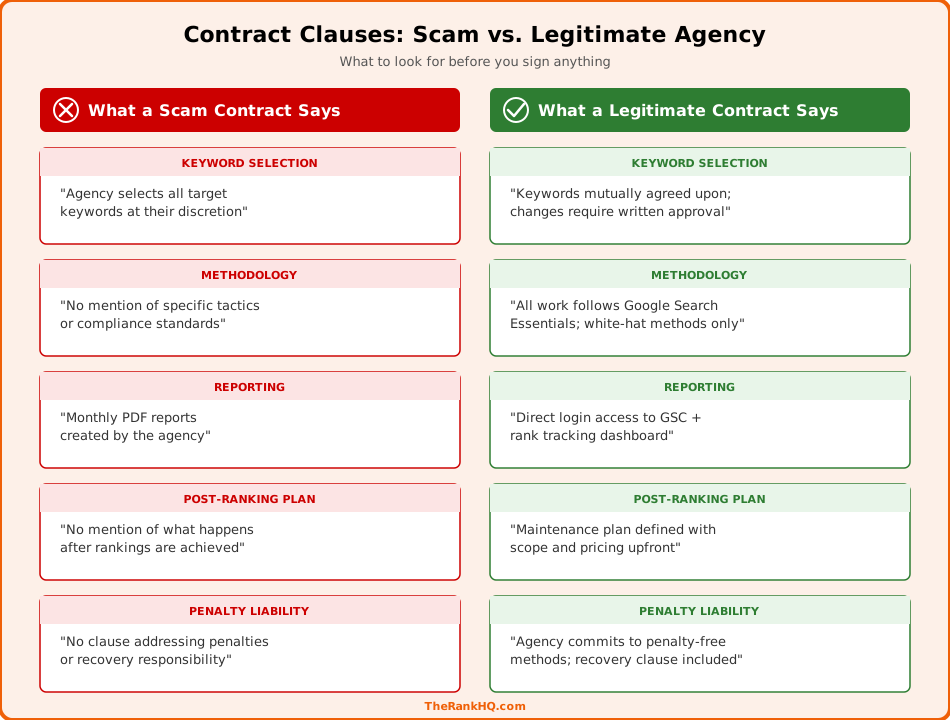
The contract tells you more than the sales call ever will. Here are five things to look for before you sign anything.
1. Keyword selection requires your approval.
You should have final say on which keywords the agency targets. If the contract lets them choose keywords unilaterally, they'll pick the easiest ones to rank for, not the ones that drive your revenue. Demand a clause that says keyword targets are mutually agreed upon, and changes require written approval.
2. White-hat methodology commitment is stated in writing.
The contract should explicitly state that all optimization work follows Google's Search Essentials (formerly Webmaster Guidelines). If they refuse to put this in writing, ask yourself why. A legitimate agency is happy to commit to ethical practices on paper because that's what they're already doing.
3. You get transparent reporting access.
The contract should specify that you receive regular reports AND direct access to tracking tools. Not just PDF reports that the agency creates (those can show whatever they want). You need login access to Google Search Console, and ideally, read access to whatever rank tracking tool they use. Real-time data you can verify independently.
4. Post-ranking maintenance terms are defined.
What happens after you hit page 1? Does the agency disappear? Does a maintenance plan kick in? Is there an additional cost? This should be spelled out before work begins, not negotiated after you're already dependent on them to maintain your rankings.
5. There's a penalty liability clause.
If the agency's work results in a Google penalty, who pays for the recovery? A confident, legitimate agency will include a clause addressing this because they know their methods won't trigger penalties. If they refuse to discuss penalty liability at all, consider what that silence tells you about their tactics.
Here's my rule of thumb: if they won't put it in the contract, they won't do it in practice.
What a Legitimate Performance SEO Engagement Actually Looks Like
So what does the real thing look like when it's done right? Not the scam version. Not the sales pitch version. The actual working engagement.
It starts with a genuine audit. Not a 2-page template. A thorough crawl of your site identifying technical issues, content gaps, backlink profile health, and competitive positioning. This takes a real agency days, not hours. You should receive a detailed report that you can understand.
Then the keyword strategy happens collaboratively. The agency researches opportunities, but you approve every target keyword based on its relevance to your business. Not just search volume. Not just difficulty scores. Actual connection to revenue.
Work progresses through defined milestones. You can see movement at each stage. And critically, you verify that movement independently using your own Google Search Console access. Nobody asks you to "just trust the reports."
One thing I think most guides get wrong in 2026: they only talk about Google rankings. If your performance agreement doesn't account for the SEO vs PPC decision in the context of AI search, you're measuring an incomplete picture. Smart performance models now track AI citation visibility alongside traditional rankings. How often does ChatGPT mention your brand? Does Gemini recommend your services? This is where the industry is heading, and it's how we approach performance SEO vs traditional retainers differently from most agencies.
Frequently Asked Questions
Can any SEO agency guarantee first-page rankings?
No. Google has stated this directly in their Search Central documentation. Rankings depend on hundreds of factors, including competition, site authority, content quality, and algorithm changes. Any agency promising guaranteed rankings is either misrepresenting what they can control or planning to use tactics that risk penalizing your site.
Is all performance-based SEO a scam?
Not at all. The model itself is sound. Paying for results rather than promises makes sense from a business standpoint. The risk comes from which agency you choose and what methods they use. Milestone-based models with transparent reporting and white-hat commitments are legitimate. Per-keyword schemes with no accountability are where the danger lives.
How much does pay-for-results SEO cost?
It varies by model. Per-keyword pricing typically runs $300 to $550 per keyword based on the ranking position achieved, according to SE Ranking's pricing survey. Milestone-based models price differently, with payments tied to project stages rather than individual keyword positions. The total investment depends on your industry competition and how many keywords you're targeting.
What should I do if my SEO agency used black-hat tactics?
First, stop all work with that agency immediately. Second, run a backlink audit using Ahrefs or Semrush to identify any spammy links pointing to your site. Third, submit a disavow file through Google Search Console for any toxic links. Finally, consider hiring a reputable agency to conduct a full recovery audit. This process typically takes 3 to 6 months, depending on the severity of the damage.
Is milestone-based SEO different from pay-per-keyword SEO?
Yes, and the difference matters. Pay-per-keyword models bill you each time a specific keyword hits a target position. This incentivizes targeting easy, low-value keywords. Milestone-based models bill you when the overall campaign reaches defined stages of progress (audit complete, position improvements, page 1 achievement). This incentivizes doing comprehensive, quality work across your entire SEO strategy, not just gaming individual keywords.
The Bottom Line
Pay-on-results SEO isn't a scam by definition. But the model attracts both the best and worst of the industry.
The best agencies use it because they're confident enough to stake their revenue on their work. The worst use it as bait, promising results while planning to cut every corner possible to collect payment fast.
The difference is in the details. The contract clauses. The transparency of reporting. The willingness to explain their methods. The quality of their references.
Use the red flags and verification steps in this article before your next call with any performance SEO agency. And if you want to see what a legitimate, milestone-based engagement looks like in practice, explore how our pay-per-rank model works and judge for yourself.
Keep reading

- SEO
How Performance-Based SEO Pricing Works: Milestones, Metrics & Payment Structures
Learn how performance-based SEO pricing actually works. Compare per-keyword, per-lead, and milestone models with real costs, red flags, and verification steps.
- SEO
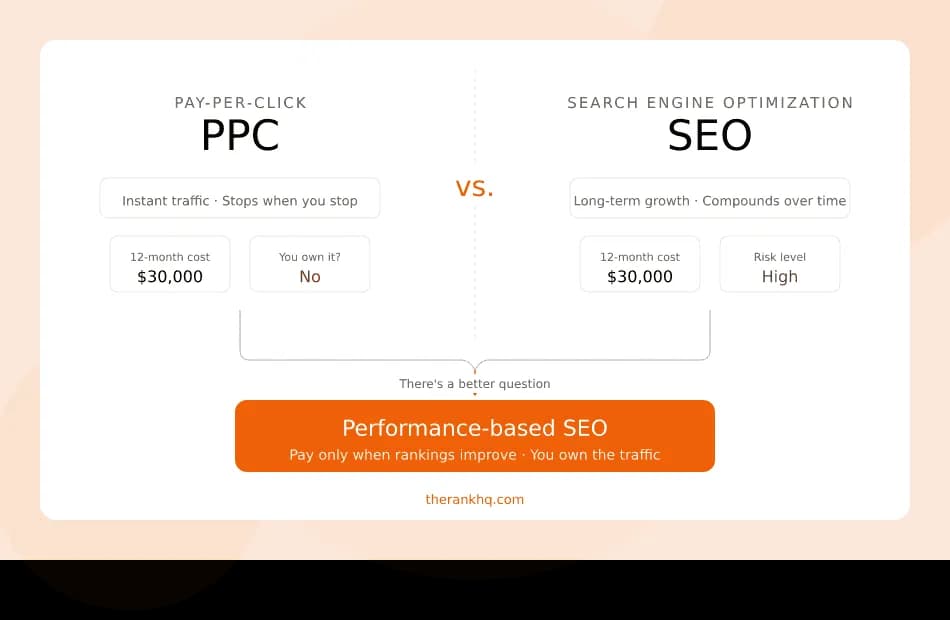
PPC vs. SEO: Which Delivers Better ROI (And Why Performance-Based SEO Changes the Equation)
PPC gives instant traffic. SEO builds long-term growth. But performance-based SEO eliminates the risk of both. See the 12-month cost breakdown.
- SEO
- AI SEO
GEO vs. SEO: How Search Optimization Is Changing in the Age of AI
Google still processes billions of searches daily. That hasn't changed. What has changed is where people go BEFORE they Google something. Or whether they Google it at all.