
Most businesses spending $2,000 or more per month on SEO retainers can’t point to a single keyword that moved because of it. They get monthly reports filled with “ongoing optimization” and “content strategy development,” but when they check Google, their rankings look the same as they did six months ago.
That’s not because SEO doesn’t work. It’s because the pricing model they chose rewards activity, not outcomes.
If you’re weighing how performance-based SEO actually works against the traditional retainer model, you’re asking the right question. This comparison breaks down what each model actually delivers, what it costs in real terms, and which one makes sense for your specific situation.
How Retainer SEO Actually Works (And What You’re Paying For)
A retainer SEO arrangement is simple: you pay a fixed monthly fee, and an agency handles your optimization on an ongoing basis. That typically includes technical maintenance, content creation, quality link building, keyword tracking, and monthly reporting.
Costs vary widely. Based on current industry data, most retainer programs run between $1,000 and $5,000 per month for small to mid-size businesses. Enterprise-level retainers can exceed $10,000. Nearly 75% of SEO providers use this model, according to a pricing analysis by Organic Media Group.
Here’s where it gets tricky. You’re paying for time and effort, not for specific outcomes. If your agency spends 40 hours on your account this month but your rankings don’t budge, you still owe the full retainer. Some agencies are transparent about this. Others hide behind “SEO takes time” for months before delivering anything measurable.
That said, retainers aren’t inherently bad. For large sites with thousands of pages that need constant technical upkeep, ongoing content production, and continuous monitoring, a retainer makes sense. The problem is when businesses paying retainer fees have no way to tell whether the work is actually moving the needle.
How Performance-Based SEO Works (The Milestone Model)
Performance-based SEO flips the risk. Instead of paying upfront for effort, you pay when specific, measurable results happen.
But not all performance models are the same. The most transparent version is milestone-based pricing. This breaks the journey to page 1 into defined checkpoints, and you pay a portion of the total fee at each one.
At TheRankHQ, our milestone-based performance SEO uses a 5-stage structure: completing the site audit and fixes, reaching position 60, hitting page 3, climbing to page 2, and finally landing on page 1. Each milestone triggers a payment. If we stall at milestone 3, you’ve only paid for the progress actually delivered.
Think of it like hiring a contractor to renovate your kitchen. You wouldn’t pay the full price before a single cabinet is installed. You’d pay in stages: after demolition, after plumbing, after installation, after finishing. That’s milestone-based SEO. Every payment is tied to something you can see and verify.
As Google’s own guidance on hiring SEO providers states, “No one can guarantee a #1 ranking on Google.” The milestone model doesn’t guarantee page 1 either. What it does is guarantee you never pay for results that didn’t happen.
The Real ROI Comparison: Let’s Do the Math
Concepts are nice. Numbers are better. Let’s walk through a real scenario.
Scenario: A local services business targeting 5 keywords.
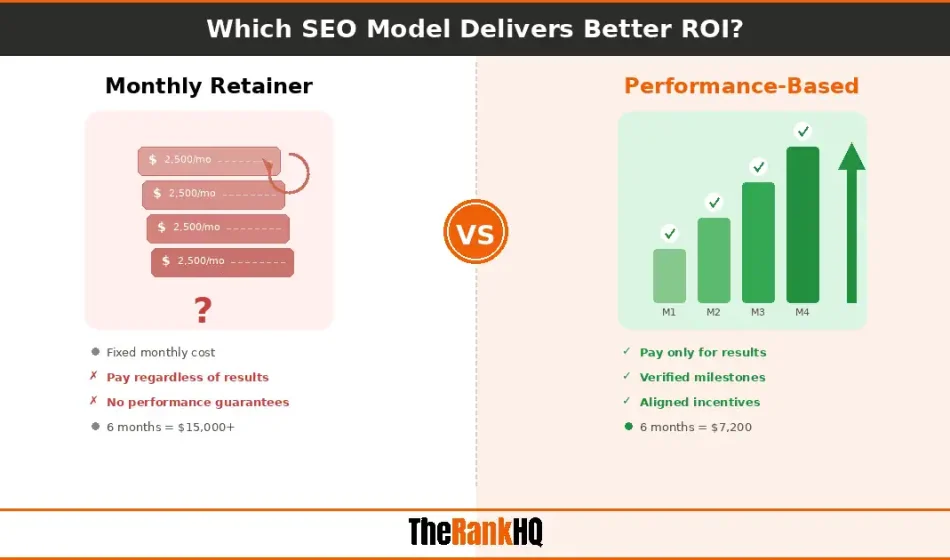
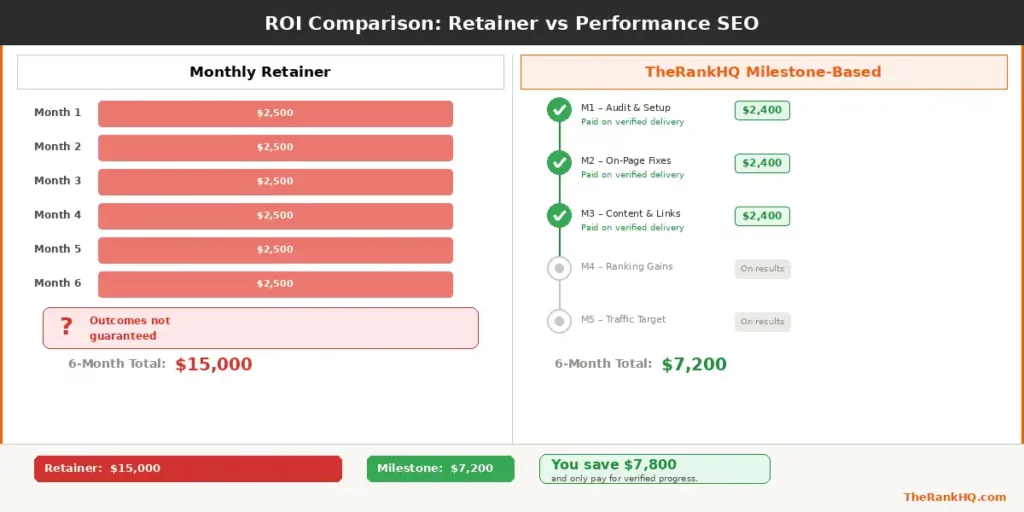
Retainer model: You sign with an agency at $2,500/month. They ask for a 6-month commitment (standard). Total spend after 6 months: $15,000. At month 6, two keywords moved from page 4 to page 2. Three haven’t moved at all. You’ve paid $15,000 for partial progress with no guarantee the remaining keywords will ever rank.
Milestone model: You agree on 5 keywords with milestone pricing. Let’s say the total cost to reach page 1 for all 5 is $12,000, split across 5 milestones. After 6 months, two keywords hit page 1 (you paid $4,800 for those milestones), and three are at milestone 2 (you paid $2,400 for that progress). Total spend: $7,200 for verified, measurable progress. The remaining $4,800 only comes due when actual rankings are achieved.
The difference: Same timeframe. Same keywords. But with the retainer, you spent $15,000 regardless of outcomes. With milestones, you spent $7,200 tied directly to results. That’s a 52% lower spend for the same (or better) progress.
I’m not saying every retainer scenario plays out this badly. Some agencies deliver great results on retainer. But the structure itself doesn’t require them to. That’s the core difference.
How to Verify What Any Agency Claims (Regardless of Model)
Here’s something most comparison articles won’t tell you: the pricing model matters less than your ability to independently verify results. Whether you’re on a retainer or performance plan, you need to know how to check the work yourself.
Google Search Console (free):
Open Search Console. Click “Search results” under Performance. Set the date range to the last 3 months. Now click “Pages” and find the URL your agency is supposedly optimizing. Check the “Average position” column.
If your agency says they moved you from position 45 to position 12 for a specific keyword, you can verify this in seconds. Click “Queries” for that page and find the keyword. The position data is right there. No agency report needed.
Ahrefs Rank Tracker:
If you have an Ahrefs account (Lite plan starts at $129/month), go to Rank Tracker. Add your domain and the keywords your agency is targeting. Ahrefs will track position changes daily and show you a historical chart.
The key thing to watch: are rankings trending upward consistently, or do they spike and drop? Consistent upward movement means real SEO work. Spikes followed by drops can signal manipulative tactics that won’t hold.
As the WebFX editorial team notes, with performance-based fees “there’s a potential for your SEO partner to focus on short-term gains or metrics that don’t benefit your business in the long run.” Verification tools catch this pattern early.
Whether you’re paying $500/month or $5,000, make these checks monthly. If an agency gets uncomfortable when you ask for Search Console access, that tells you everything you need to know.
The Honest Downsides of Each Model
I’d be doing you a disservice if I only talked up one side. Both models have real weaknesses.
Retainer risks:
Scope creep is the biggest one. You sign up for SEO, and suddenly the agency is billing retainer hours for “social media monitoring” and “brand strategy calls.” Without clear deliverables tied to each monthly payment, retainer work can drift far from what actually moves rankings.
The other issue is the “SEO takes time” shield. Yes, SEO genuinely takes months. But some agencies use this reality as cover for doing very little. If you’re 4 months into a retainer and can’t see any movement in Search Console, something is wrong.
Performance risks:
Not every keyword qualifies for performance-based pricing. Highly competitive terms with massive domain authority competitors may not be realistic targets for a milestone model. A responsible agency will tell you upfront which keywords they can and can’t take on.
There’s also the narrow scope concern. If a performance contract only covers 5 specific keywords, the agency has no incentive to fix broader site audit issues or optimize pages outside the contract scope. You might rank for those 5 terms while the rest of your site stagnates.
The smartest approach? Ask hard questions before signing either model. What exactly am I paying for each month? How will I verify progress? What happens if results don’t come?
Which Model Is Right for You?
There’s no universal answer. But there are clear patterns.
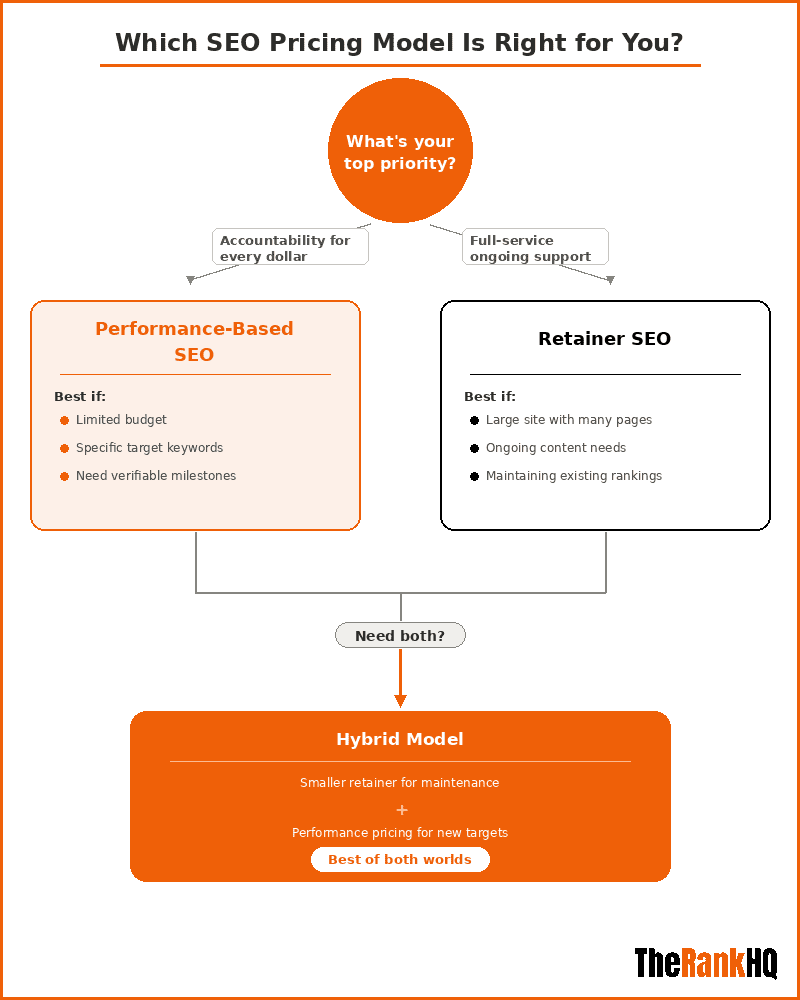
Choose performance-based SEO if:
You’re a small or mid-size business with a defined set of target keywords. You’ve been burned by retainers before and need accountability built into the structure. Your budget is limited and you can’t afford to pay $3,000/month for 6 months hoping something happens. You want to see exactly what you’re paying for at every stage.
Choose a retainer if:
You’re running a large site (500+ pages) that needs constant technical maintenance and content production. You already have solid rankings and need an agency to maintain and expand your organic presence. You need full-service support beyond just rankings: content strategy, AI search optimization, conversion rate work, and ongoing reporting.
Consider a hybrid if:
You want the accountability of performance pricing for new keyword targets combined with a smaller retainer for ongoing maintenance and technical upkeep. This is becoming more common in 2026, and honestly, for many businesses it’s the best of both worlds.
Frequently Asked Questions
Can you switch from retainer to performance-based SEO mid-contract?
It depends on your contract terms. Most retainer agreements include a notice period (30 to 90 days). Review your cancellation clause before making any moves.
If you’re switching because results haven’t come, document the lack of progress using Google Search Console data before the conversation. Numbers make the case better than frustration.
What’s the average cost of performance-based SEO compared to a retainer?
Retainers typically range from $1,000 to $5,000/month for small and mid-size businesses. Performance-based costs vary by keyword difficulty, but the total project cost often ends up 20 to 40% lower because you’re not paying for months of no movement.
The real comparison isn’t monthly cost. It’s cost per result achieved.
Do performance-based SEO agencies use black hat tactics to hit milestones faster?
Some do. That’s exactly why verification matters. Check for sudden ranking spikes followed by drops. Look at the backlink profile in Ahrefs. If you see hundreds of low-quality links appearing overnight, that’s a red flag.
Legitimate performance agencies (including TheRankHQ) use the same white-hat strategies any good retainer agency would. The difference is in the payment structure, not the methodology.
How long before I see results with either model?
Both models operate on the same SEO timeline. Expect 3 to 6 months for meaningful movement on moderately competitive keywords. The difference is that with a retainer, you’re paying the full fee during those months regardless. With performance pricing, your payments scale with actual progress.
What should I look for in an SEO contract regardless of model?
Three things. First, clear deliverables tied to each payment. Second, your own access to Google Search Console and any rank tracking tools so you can verify independently. Third, a defined exit clause that doesn’t lock you in if results aren’t coming.
As Google’s Search Central documentation advises, a trustworthy SEO provider should be willing to give you “full access to your site’s analytics and server logs.”
The Bottom Line
The model you choose matters less than what you demand from it. If you’re on a retainer, insist on measurable milestones and monthly verification through your own Search Console access. If you’re on performance pricing, make sure the scope covers what your business actually needs, not just 5 keywords in a vacuum.
But if I’m being straight with you? For most small and mid-size businesses in 2026, performance-based pricing simply aligns incentives better. You pay for progress. The agency earns when they deliver. Nobody hides behind vague monthly reports.
If that sounds like the accountability you’ve been looking for, take a look at our pay-per-rank model and see how the milestone structure maps to your goals. Or check our SEO pricing and packages to compare options side by side.
