
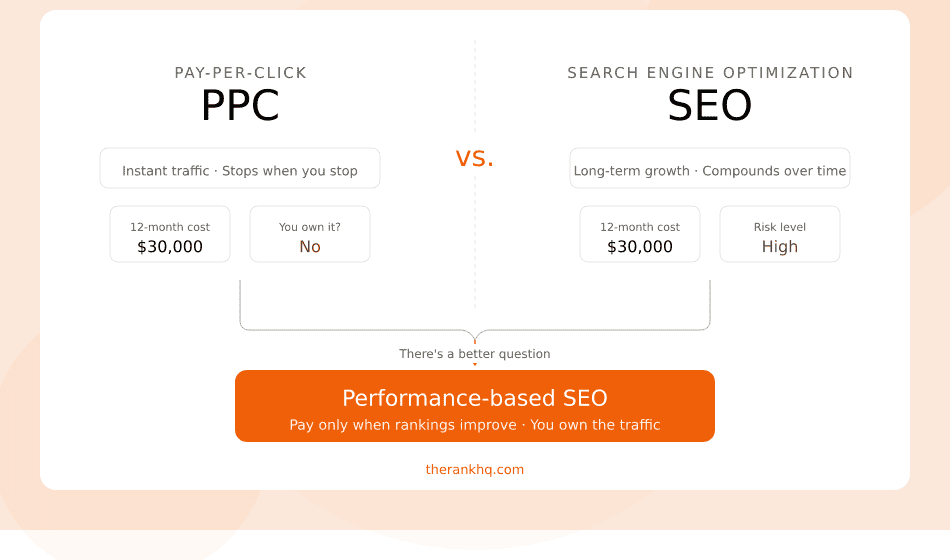
Every guide on this topic gives you a comparison table, lists the pros and cons, and then tells you to “use both.” That’s not a strategy. That’s a non-answer dressed up as advice.
I’ve managed milestone-based performance SEO campaigns across 200+ businesses. And here’s what I’ve noticed: the PPC vs SEO debate misses the point entirely. The real question isn’t which channel is better. Which payment model eliminates the risk that makes this debate exist in the first place?
If you’ve been burned by an SEO agency that charged $2,500 a month for six months and delivered nothing, PPC starts looking really attractive. But if you’ve watched your Google Ads budget drain at $12 per click with a 3% conversion rate, SEO sounds like the smarter play.
Both frustrations are valid. And both point to the same underlying problem: you’re paying for effort or clicks, not for results. This guide breaks down what PPC and SEO actually cost over 12 months, where each one wins, and why a third option exists that most comparison guides completely ignore.
What PPC Actually Costs You (Beyond the Click)
PPC, or pay-per-click advertising, puts your business at the top of Google’s search results the moment you start paying. You bid on keywords. When someone searches for those keywords, your ad shows up. You pay every time someone clicks.
Sounds simple. But the math gets uncomfortable fast.
Let’s say you’re a local service business bidding on “plumber near me.” According to WordStream’s 2025 Google Ads Benchmarks, the average cost per click increased across 87% of industries last year. For home services, you’re looking at $8 to $15 per click, depending on your market.
That means 200 clicks a month costs you $1,600 to $3,000. If your conversion rate sits around the industry average of 3-5%, you’re getting 6 to 10 leads from that spend. Some of those leads won’t pick up the phone. Some will price-shop. Maybe 3 to 5 turn into actual customers.
Here’s the part that stings: the moment you stop paying, your traffic drops to zero. Literally overnight.
Think of PPC like renting a billboard on a busy highway. Great visibility while you’re paying. But the second your lease ends, your sign comes down, and nobody remembers you were there.
That doesn’t mean PPC is bad. It’s excellent for specific situations. But the cost structure means you’re always on the treadmill, always feeding the machine. And with CPCs climbing year over year, that treadmill gets faster and more expensive.
In Google’s own words on their SEO vs PPC resource: “A PPC ad solution like Google Ads doesn’t have the same results as SEO and won’t improve your organic search rankings.” They’re separate systems entirely.
What SEO Actually Costs You (And What You Get Back)
SEO is the process of making your website show up in Google’s organic results, the ones below the ads, without paying for each click.
But “free traffic” is misleading. SEO isn’t free. It costs time, effort, and usually money. The difference is in what you’re building.
A typical SEO campaign starts with a technical site audit to find and fix crawl errors, speed issues, and structural problems that prevent Google from understanding your pages. Then comes keyword research, content creation, on-page optimization, and link building. That work compounds over time.
Here’s why the math is different from PPC. According to First Page Sage’s SEO ROI research, the average minimum ROI for SEO is 500%, or a 5:1 return. For transactional content specifically, that number jumps to 748%. And unlike PPC, the traffic doesn’t disappear when you stop actively investing.
I’ve seen blog posts we published 18 months ago still bringing in consistent organic traffic every single week. That page didn’t cost us a dime in month 18. The investment was made once, and it keeps paying back.
If PPC is renting a billboard, SEO is buying the building. It takes longer. The upfront investment is real. But you own the asset. Nobody can turn it off by outbidding you.
The catch? Traditional SEO pricing usually means a monthly retainer. $1,500 to $5,000 per month is the standard range for most agencies. And here’s where the frustration kicks in: you pay that retainer whether your rankings improve or not. That’s the exact same risk model that makes people skeptical of SEO in the first place.
The 12-Month Cost Reality Check
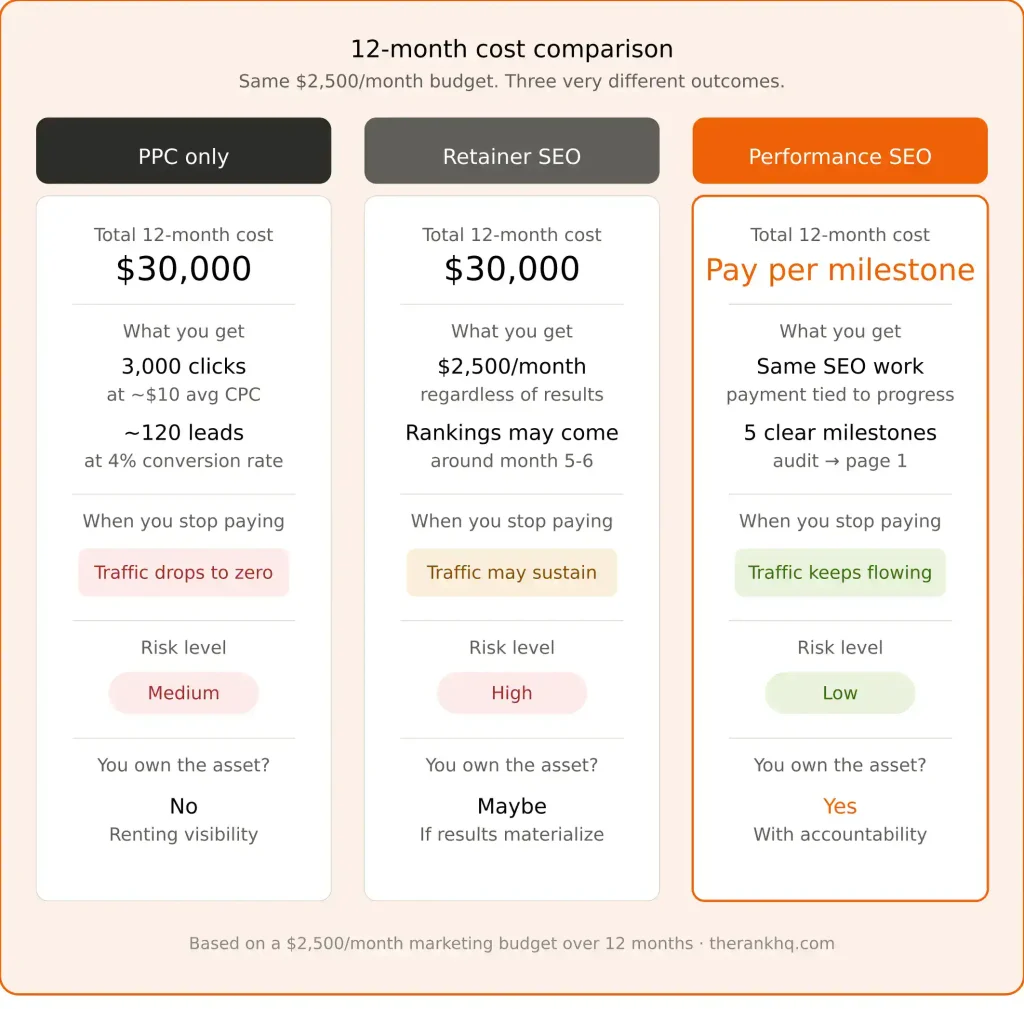
Let me walk through what these numbers actually look like over a year. This is the comparison most guides skip because it makes the math uncomfortable.
Scenario: A local service business with a $2,500/month marketing budget.
Path 1 — PPC Only: $2,500/month in Google Ads spend. At a $10 average CPC, that’s 250 clicks per month and 3,000 clicks per year. With a 4% conversion rate, you get roughly 120 leads over 12 months. Total spent: $30,000. The day you pause your campaign, leads drop to zero.
Path 2 — Traditional Retainer SEO: $2,500/month to an agency on retainer. Over 12 months, you’ve invested $30,000. If the agency is competent, you might start seeing meaningful ranking improvements around month 5 or 6. But there’s no guarantee. I’ve talked to dozens of business owners who paid $30,000 over a year with nothing to show for it. The agency was “working on it.” The invoices kept coming. The results didn’t.
Path 3 — Performance-Based SEO: You pay when milestones are hit. Does the agency complete your technical audit and fix it? That’s milestone one. Keywords move to the top 60? Milestone two. Page 3? Milestone three. Page 1? Final milestone. Your total investment is tied directly to measurable progress. If nothing moves, you don’t pay.
Same destination. Very different risk profiles. You can dig deeper into how performance-based SEO compares to monthly retainer models and see exactly where the cost structures diverge.
The important thing to understand here is that Path 3 isn’t some theoretical concept. It’s the model we run at TheRankHQ across every client engagement. And it exists precisely because Paths 1 and 2 both have a fundamental flaw: the person paying carries all the risk.
What Both Sides Miss: AI Search Is Changing Everything
Here’s something neither PPC advocates nor traditional SEO guides are talking about yet.
Your customers aren’t just searching Google anymore. They’re asking ChatGPT for recommendations. They’re using Gemini to compare service providers. They’re getting direct answers from Perplexity without ever seeing a list of blue links.
Research from SparkToro shows that roughly 60% of Google searches now end without a click. AI Overviews answer the question directly on the results page. Zero-click searches are eating into both paid and organic traffic.
Now think about what this means for PPC. You can’t buy an ad inside ChatGPT’s response. There’s no bidding system for Gemini’s recommendations. Your Google Ads budget does absolutely nothing for AI search visibility.
And traditional SEO? It helps, but not automatically. AI engines don’t just scan for keywords. They look for structured, authoritative content with clear entity signals and verifiable expertise. That’s where AI search optimization becomes its own discipline.
This is the dimension that makes the PPC vs SEO debate feel incomplete. There’s now a third surface where your customers find answers, and neither a Google Ads budget nor a basic SEO retainer covers it. The businesses that will win over the next 2-3 years are the ones building content that ranks on Google AND gets cited by AI engines at the same time.
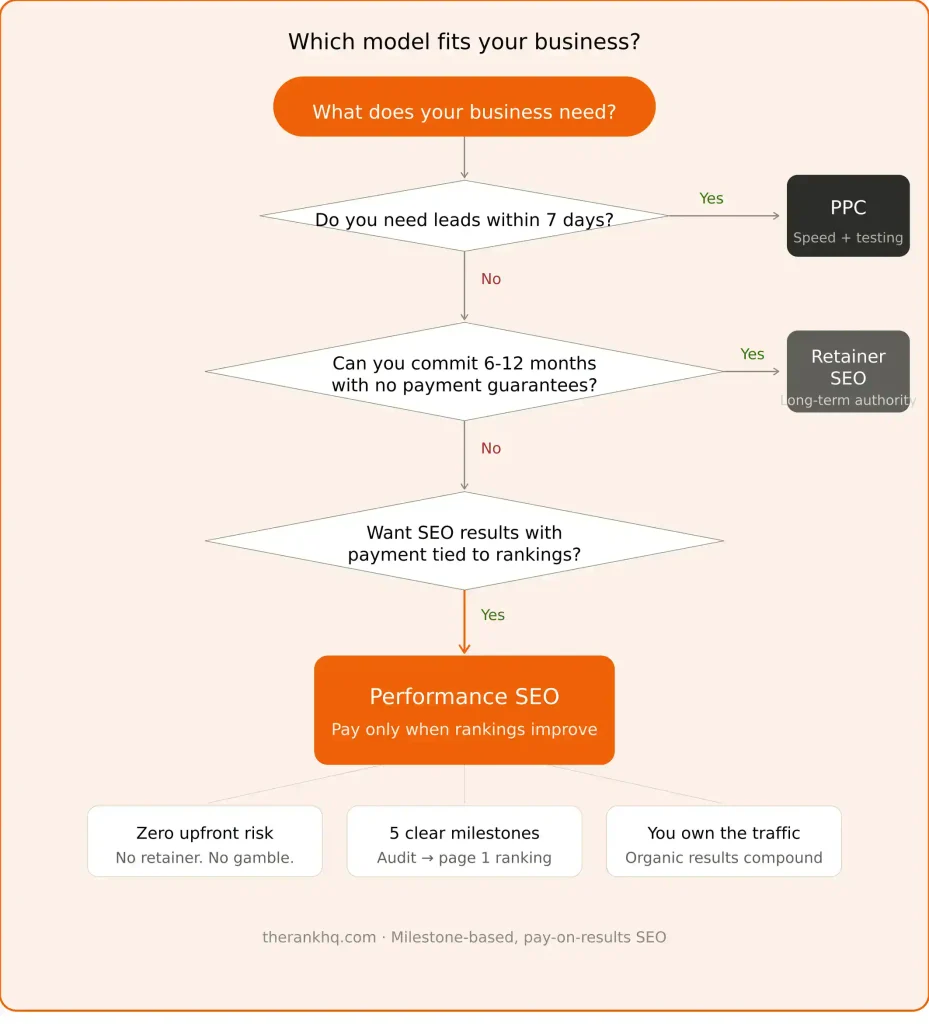
When PPC Wins, When SEO Wins, and When Performance SEO Wins
I’m not going to tell you to “use both” and leave it at that. Here’s a more honest framework.
PPC wins when:
You’re launching a new product or service and need leads this week. You’re running a seasonal promotion with a hard deadline. You want to test which keywords actually convert before investing in long-term content. Or you’re in a hyper-competitive space where organic rankings will take 12+ months, and you need revenue now to survive.
PPC is a tool for speed and precision. It’s not a long-term growth strategy. It’s a tactical weapon.
SEO wins when:
You want traffic that compounds over time instead of resetting to zero every month. You’re building brand authority in your industry. You want to show up in Google’s organic results AND in AI-generated answers. Or you’re competing on trust, and your customers are more likely to click on an organic result than a paid ad.
According to industry data, top organic results consistently earn higher click-through rates than paid ads. People trust earned visibility more than bought visibility. That trust matters, especially in industries where credibility drives purchasing decisions.
Performance-based SEO wins when:
You’ve been burned by retainer agencies and can’t stomach another open-ended monthly payment with no accountability. You’re a small-to-mid business with a real marketing budget but zero tolerance for wasted spend. You want SEO results but need the financial safety net of only paying when rankings actually move. Or you want a partner whose incentives are perfectly aligned with yours.
If you’re curious about what performance-based SEO looks like in practice, we’ve broken down the entire model: the milestones, the pricing, the risks, and who it works best for.
FAQ
Is PPC or SEO better for small businesses on a tight budget?
For most small businesses, SEO delivers stronger long-term value per dollar. PPC burns through budget quickly, especially in competitive industries where CPCs exceed $10-15 per click.
But here’s the nuance most guides miss: the real budget killer isn’t PPC or SEO itself. It’s paying for SEO on a monthly retainer with no results. If your budget is tight, performance-based SEO gives you the long-term benefits of organic search without the open-ended financial risk. You can explore SEO pricing tiers and what they actually include to compare options.
How long does SEO take to show results compared to PPC?
PPC delivers traffic within hours of launching a campaign. SEO typically takes 4 to 8 months for meaningful ranking improvements, depending on competition and your site’s existing authority.
That timeline scares people. But here’s what they don’t consider: PPC traffic vanishes the day you stop paying. SEO traffic keeps flowing for months or years after the initial work is done. The question isn’t just “how fast” but “how long does it last.”
Can I run PPC and SEO at the same time?
Yes, and for many businesses it’s the smartest approach. Use PPC to generate immediate leads while your SEO builds momentum. As organic rankings improve, you can gradually reduce PPC spend on the keywords where you’re now ranking organically.
The trick is not running them in separate silos. Your PPC keyword data tells you which terms actually convert. Feed that data into your SEO strategy so you’re building organic content around proven, revenue-driving keywords.
What is performance-based SEO, and how is it different from regular SEO?
Performance-based SEO uses the same optimization techniques as traditional SEO: technical fixes, content creation, and link building. The difference is entirely in the payment model.
With a traditional retainer, you pay a flat monthly fee regardless of results. With performance-based SEO, payment is tied to measurable milestones like reaching specific ranking positions. If your keywords don’t move, you don’t pay. It shifts the financial risk from the business owner to the agency, which is why most agencies avoid offering it.
Does PPC help with SEO rankings?
No. Google has stated clearly that running Google Ads does not influence your organic search rankings. PPC and organic search are separate systems.
That said, PPC can indirectly support SEO by driving traffic to new pages, generating brand awareness that leads to more branded searches, and providing keyword conversion data that informs your content strategy. But one doesn’t directly boost the other.
The Bottom Line
PPC rents visibility. SEO builds it. Performance-based SEO builds it with accountability built into every milestone.
If you need leads tomorrow, run PPC. If you’re building something that lasts, invest in SEO. And if you’ve been paying monthly retainers with nothing to show for it, there’s a model that only charges you when rankings actually improve.
That’s what we do at TheRankHQ. No upfront fees. No retainer guessing games. Just pay-on-results SEO where our success is directly tied to yours.
