Custom Web Design for Austin Businesses Built to Rank and Convert
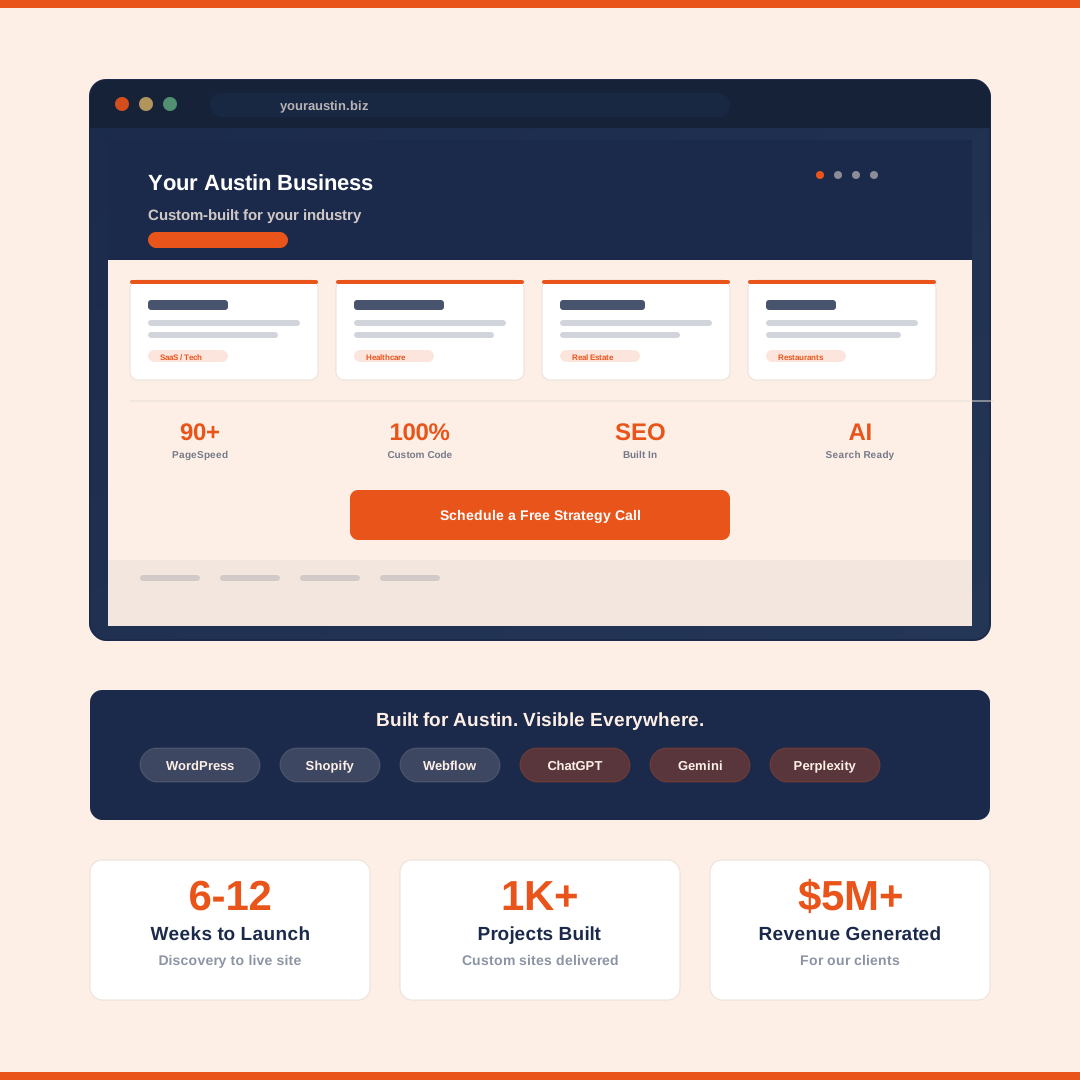
Austin's tech-driven economy moves fast. Your website should move faster. We build custom websites for Austin businesses, from SaaS startups on South Congress to medical practices near Dell Seton, designed for both human visitors and AI search engines like ChatGPT and Perplexity.
Why Austin's Template Websites Are Losing Leads to Competitors
SaaS companies, healthcare systems, real estate firms, and creative agencies drive Austin's economy. The metro ranked No. 1 among large US cities for job growth in 2025, adding 27,200 jobs at a 2.0% growth rate (Source: Opportunity Austin / U.S. Bureau of Labor Statistics). That means thousands of new businesses entering the market every year, all competing for the same customers online.
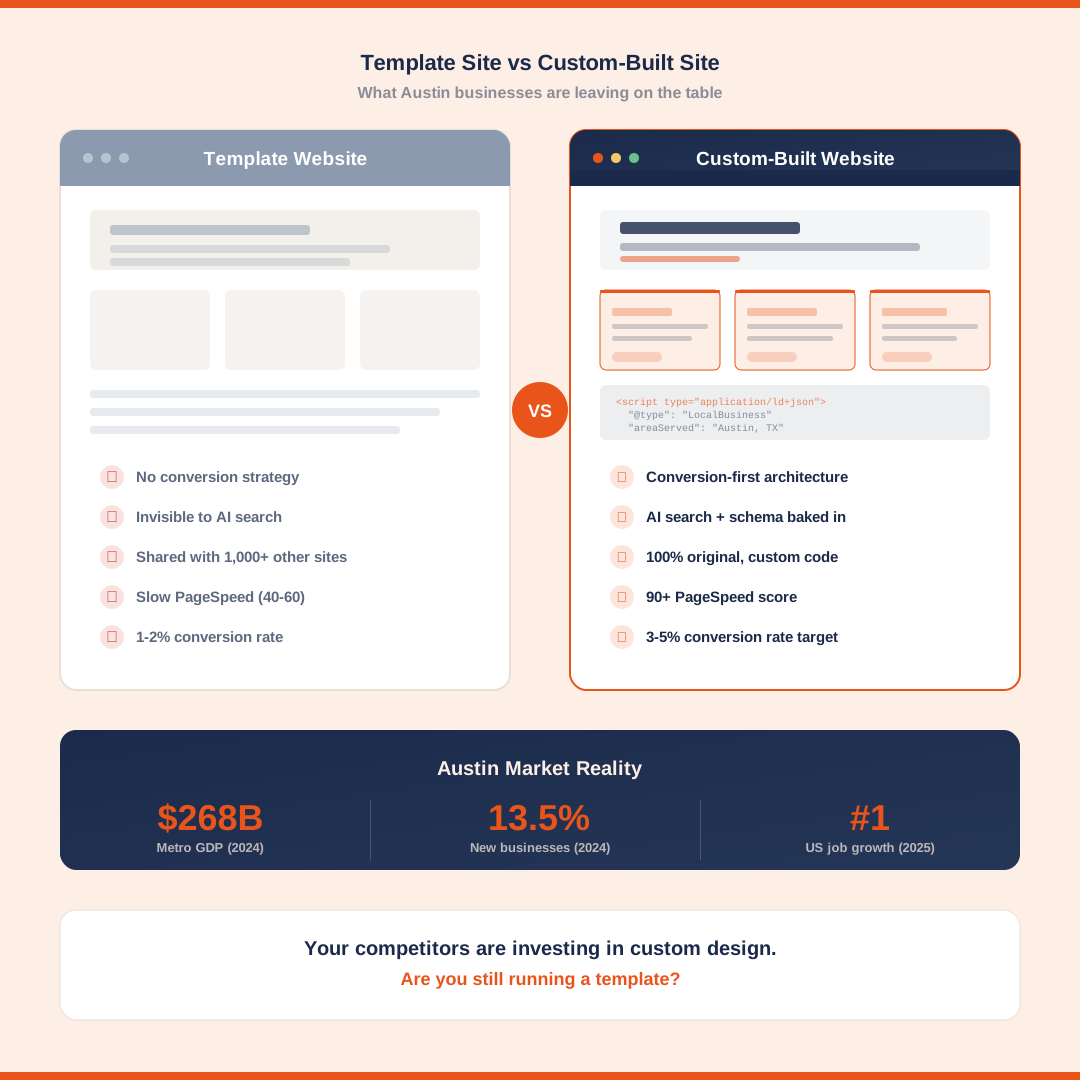
Most of them launch with a template. A $500 theme, stock photos, and a contact form that looks like every other site their competitor bought from the same marketplace. In 2026, those cookie-cutter sites are invisible to AI search tools like ChatGPT and Perplexity because they lack structured data or extractable content.
In a city where 13.5% of all businesses were newly founded in 2024 alone (Source: USA Today / UT McCombs School of Business), your competitors are constantly refreshing their online presence. A site that looked fine two years ago now signals stagnation.
Years of experience
8+
Satisfied clients
100+
Countries served
7+
Revenue generated
$10M+
Austin Web Design Services
Six Things Our Austin Web Design Company Builds
Six core services, each built around what Austin businesses actually need from their websites. Not a menu of generic options with your city name dropped in. More on how we approach custom web design.
Custom Website Design
We design and build every page from scratch. No pre-made themes, no drag-and-drop builders. Your Austin business gets a site coded specifically for your industry, your audience, and the search queries your customers are actually typing.
WordPress Development
About 40% of the web runs on WordPress for good reason (Source: W3Techs, 2026). We build custom WordPress sites that score 90+ on PageSpeed Insights, with clean admin panels your team can update without calling a developer every week.
Ecommerce & Online Stores
If your Austin business sells products online, your store needs more than a catalog. We build Shopify and WooCommerce stores with checkout flows designed to reduce abandonment and increase average order value.
Website Redesign
When was the last time your site actually brought you a lead? If you can't remember, it's time. We handle full website redesigns with content migration, 301 redirect mapping, and zero SEO value lost in the transition.
Landing Pages Design
A single well-built landing page can outperform a 20-page website for lead generation. We build conversion-focused pages with A/B testing structures, scroll-triggered CTAs, and form flows that cut friction to almost nothing.
AI Search-Ready Architecture
Every site we build is structured so AI tools like ChatGPT, Gemini, and Perplexity can find, read, and cite your content. Schema markup, answer-first content blocks, and clean semantic HTML, all installed at the code level, not bolted on later.
Industries We Serve
From Clinics to Contractors: What Each Austin Industry Needs Online
Austin's economy isn't one thing. SaaS startups in Silicon Hills have completely different website needs than healthcare practices near Dell Medical or real estate firms covering the booming suburbs. Each industry in this city needs a site built for how its customers actually find and evaluate businesses.
Project gallery pages with before-and-after layouts, service area maps, quote request forms with scope selectors, licensing and certification displays, and manufacturing-grade web design with review integration from Google and HomeAdvisor
Comparison Table
Custom Web Design vs Templates vs DIY Builders: The Austin Breakdown
Not every Austin business needs a fully custom website. Some do. Here's an honest look at the three main approaches so you can pick the one that makes sense for your budget, your goals, and where your business is right now.
Feature
Custom Web Design
Template (ThemeForest, etc.)
DIY Builder (Wix, Squarespace)
Design uniqueness
100% original, built for your brand
Shared with thousands of other sites
Limited templates, minor customization
Conversion optimization
CTA placement, form flows, and layout based on user behavior data
Growing businesses that need results from their site
Budget-tight businesses that want to look professional quickly
Solo operators testing a business idea
Neighborhoods
From SoCo to the Domain: Web Design Across Austin's Districts
Austin isn't one market. The businesses in each district serve different customers, face different competition, and need different things from their websites. We understand those differences.
Downtown / Second Street District
Corporate offices, fintech firms, hospitality venues, and professional services are concentrated in Austin's urban core. Websites here need polished corporate design, investor-facing content, and fast-loading mobile experiences for the lunch-break browser.
South Congress (SoCo) & South Austin
Boutiques, restaurants, creative studios, and local retail. These businesses need brand-forward design, strong visual identity, ecommerce or menu integration, and local SEO that captures foot traffic from both residents and visitors.
The Domain / North Austin
Tech company campuses (Apple, Meta), retail, dining, and medical offices. Sites for businesses here skew corporate or enterprise-adjacent, with polished UI, demo funnels, and content that positions them alongside the big names nearby.
East Austin
Breweries, creative agencies, small tech shops, and service businesses in a fast-changing Austin neighborhood. These businesses need websites that reflect their brand personality, load fast on mobile, and rank for hyper-local search terms.
Silicon Hills Corridor (183/360)
SaaS companies, dev shops, and B2B firms along Austin's tech corridor. Websites need product marketing pages, documentation sections, integrations with demo tools, and content structured for both Google and AI search citation.
Bee Cave / Lakeway / Westlake
Luxury real estate firms, dental practices, wealth management, and high-end service providers serving Austin's western suburbs. Sites here demand trust-heavy design, client portals, and IDX integration for the luxury property market.
Austin Website Design Strategy
How Our Austin Web Design Company Takes a Site From Brief to Launch
Austin's market doesn't wait. Your competitors are launching new sites, updating their content, refreshing their brands. Our process is designed to move at startup speed without cutting corners. Refined across 100+ client projects, most sites launch in 2 to 6 weeks.
1Discovery
Discovery Call and Austin Competitor Audit
You talk, we take notes. The discovery call covers how your company makes money, who signs the contract or books the appointment, and what a visitor has to believe before doing either. Austin adds its own wrinkle: a steady stream of new residents and new companies with no local referral network, who pick a dentist, a roofer or a software vendor from search results and AI answers. We study the competitors those newcomers see first, then write your project brief.
Pin down your revenue model, buyer types and highest-value conversions
Pull analytics, Search Console and heatmap data from your existing site
Audit the Austin competitors ranking for the searches you want
Capture brand voice, visual references and messaging priorities
Write the project brief that governs scope, design and build
2Architecture
A Figma Sitemap Sized for Austin's Suburbs and Verticals
Before design, you get a sitemap you can click through in Figma, showing every page and how they link. For Austin companies the hard calls are usually geographic or vertical. Does a home services firm need separate pages for Round Rock, Cedar Park and Lakeway? Does a SaaS product need pages per use case, per integration or per industry? Each page that survives the cut gets a clean URL, a place in the navigation and a defined job, so nothing is built on a hunch.
Lay out every page and navigation path in a Figma sitemap
Choose service-area pages by search demand, not by guesswork
Structure URLs with short slugs and sensible nesting
Give each page a content outline, a primary action and a schema type
Add breadcrumbs and internal links between related pages
3Wireframes
Wireframes That Turn Austin Traffic Into Leads
A wireframe is a page stripped to its structure: what appears first, what the visitor can do next, and what proof sits beside the button. Your Austin startup's homepage might lead with the product claim and a demo form for someone arriving from a pitch deck link. A South Congress restaurant needs hours, menu and reservations within a thumb's reach. You approve these layouts in grayscale, when moving a section costs minutes instead of days.
Wireframe the homepage and each key interior page
Set call-to-action placement from scroll-depth and click patterns
Shorten forms and add inline error messages
Put reviews, logos and credentials where hesitation happens
Design the phone layout first, then scale up
4Design
Design in Figma With Austin Character, Not a Theme
Now the wireframes get a face. We design in Figma from a blank file, building your color palette, type scale and components instead of reskinning a theme. Character counts for a lot here. An East Austin brewery, a Westlake wealth practice and a developer tool on the 183 corridor each have a point of view, and a stock template flattens all three into the same site. You review full mockups for desktop and mobile before any code is written.
Create a custom design system with palette, typography and spacing
Mock up the homepage and core templates in full color
Design responsive breakpoints from small phones to wide monitors
Define hover states, transitions and small interactions
Annotate the Figma file for a clean developer handoff
5Development
Hand-Coded Development for Austin Startups and Service Firms
Your site is coded by hand. No page builder, no stack of plugins. We pick the platform with you: WordPress when your team publishes often, Shopify when you sell products, Webflow when marketing wants visual control, a headless CMS when your engineers want the front end in their own stack. That last option comes up often with Austin software companies. Integrations are wired in during the build, from a CRM and scheduling tool to online ordering or an IDX property feed, then tested on staging.
Build on WordPress, Shopify, Webflow or a headless CMS
Write semantic HTML, lean CSS and minimal JavaScript
Set up editing fields, user roles and permissions for your staff
Integrate CRM, scheduling, ordering, payment or IDX tools
Run the whole site on staging before your domain changes
6SEO + AEO
SEO and AEO for Austin's Newcomers and AI Assistants
People new to Austin cannot ask a neighbor of ten years for a recommendation. They ask Google, and more of them now ask ChatGPT or Perplexity. Your site is built so both can read it: one topic per page, descriptive headings, schema markup for your organization, services and FAQs, and short paragraphs that answer a question outright. Texas rules shape the page too. A broker's site needs its TREC links on the homepage and a plumber's site needs the license number.
Set titles, meta descriptions and heading structure on every page
Mark up Organization, Service, FAQ and breadcrumb structured data
Shape key content into direct answers AI tools can quote
Compress images, convert to WebP and add alt text
Install GA4 and Search Console with conversions tracked
7Launch
Launch Checks Before Austin's Busy Seasons Hit
Timing a launch matters in Austin. A restaurant, venue or hotel wants the new site live well ahead of SXSW in March or the ACL and Formula 1 weekends in October, not in the middle of them. Before go-live we test on real devices, check page speed and Core Web Vitals, run WCAG accessibility checks, and redirect old URLs so rankings transfer. Then your team gets CMS training, and the 30-day support period starts the day the site goes public.
Test on current browsers plus real iPhone and Android devices
Measure Core Web Vitals, then speed up slow templates
Check color contrast, keyboard access and screen reader output
Redirect every old URL with a 301 map
Hold a live CMS walkthrough and hand over written guides
What You Get
Six Deliverables Every Austin Web Design Project Includes
Austin moves fast, so nothing about scope is left vague. These six deliverables are in every project, agreed in writing before we design a page.
Project Brief & Sitemap
Your strategy on paper, plus the map of every page we will build.
Audience, goals and conversion targets
Figma sitemap with navigation paths
URL and internal link plan
Wireframe Documents
Grayscale layouts for each key page, signed off before design starts.
Homepage and interior page structures
Button, form and proof placement
Phone and desktop versions
Visual Design Mockups
Finished-looking designs in Figma for you to review and approve.
Full-color homepage and template designs
Layouts for every screen size
Custom component library for your brand
Fully Built Website
Your coded, tested site, launched on the domain you own.
Custom code, no builder or theme
CMS set up for your workflow
SEO, schema and analytics installed
CMS Training Package
What your team needs to run the site without calling a developer.
Written guide to everyday edits
Live walkthrough of the admin
Roles and logins for each editor
30-Day Support Period
Thirty days of help once the site is in front of real customers.
Fixes for anything that breaks
Minor content and layout changes
Performance checks on the live site
Case studies
Custom Websites We've Launched, and How They Performed
These are sites we designed from scratch, with a conversion strategy and SEO architecture built into every page. Not just "nice design." Sites built to be found on search engines and in AI answers.
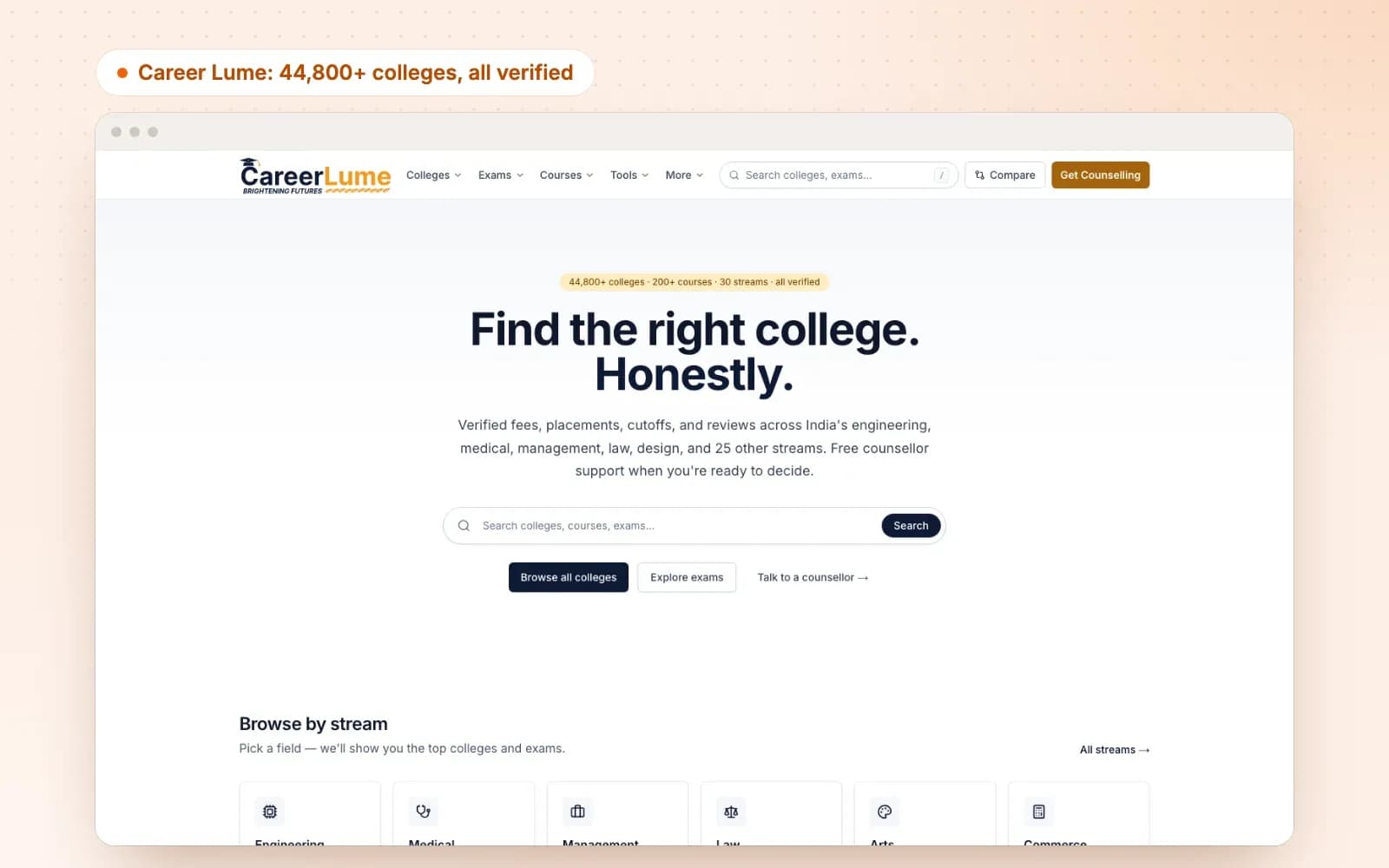
TheRankHQ designed and built Career Lume from scratch: a college discovery platform for Indian students with more than 44,800 verified college profiles, five free college predictors and a career assessment, built to be honest where college portals usually are not.
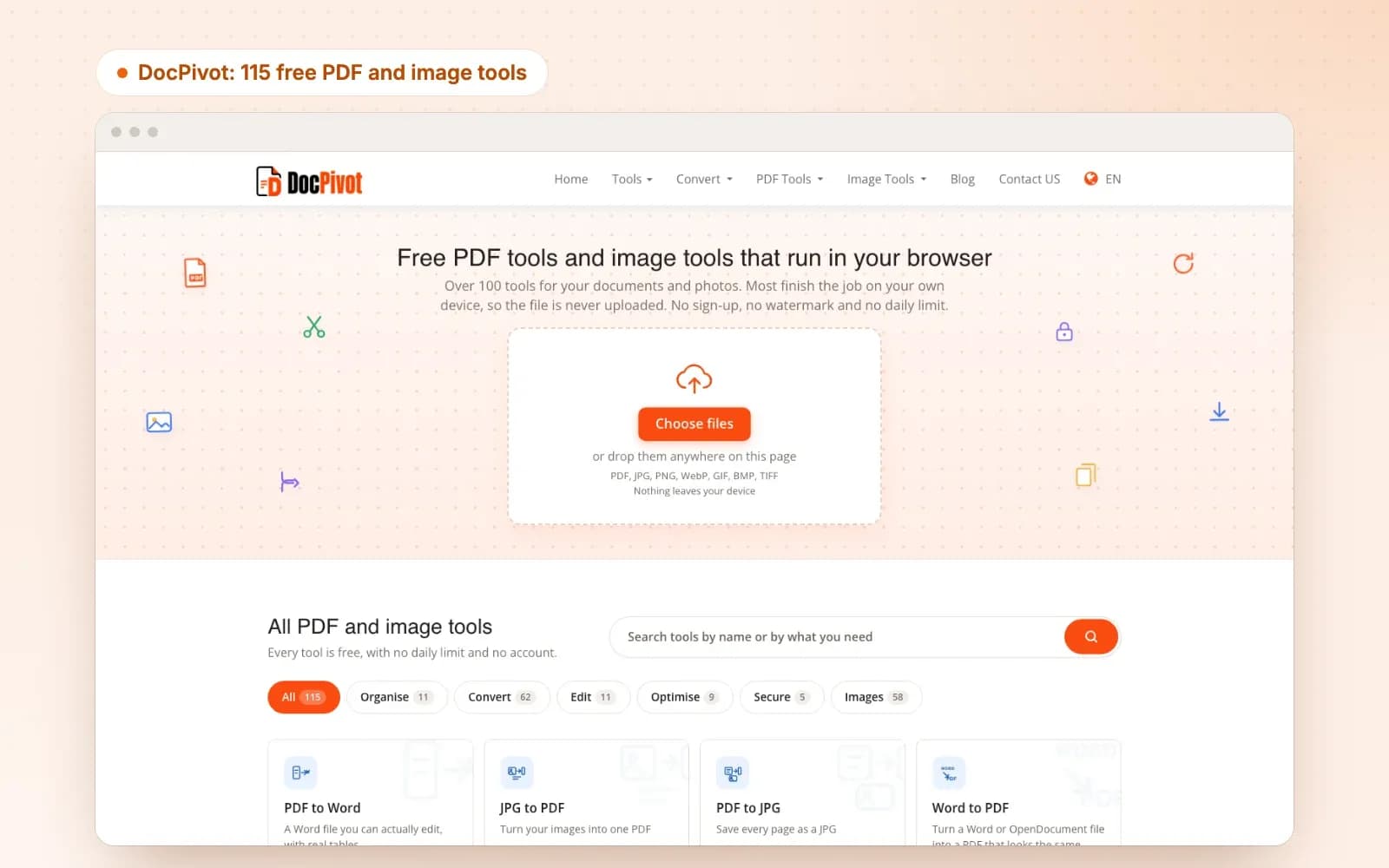
TheRankHQ designed and built DocPivot from scratch: 115 free PDF and image tools in one workspace, 82 of which never upload the file. It was planned around what established tools get wrong: daily limits, sign-ups, watermarks and re-uploading between every step.
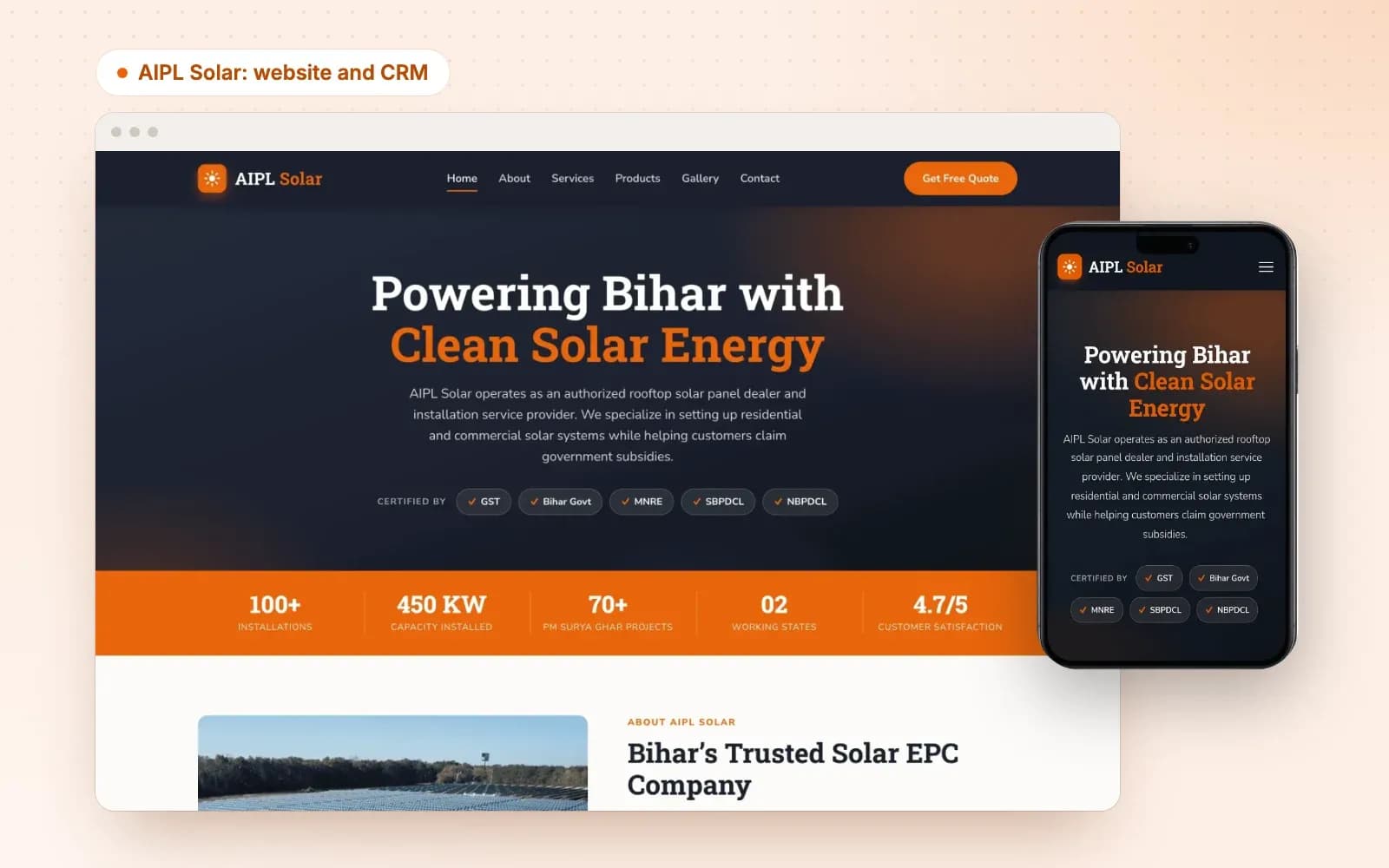
A growing solar installer in Bihar was running its business across government portals, billing software, sales apps, inventory tools and spreadsheets. We designed and built a custom website and a CRM dashboard that brings leads, projects, finances and the team into one place.
An Austin Web Design Company That Also Builds Coast to Coast
From SaaS startups in Austin to healthcare practices in Chicago and financial services firms in New York, we build custom websites for businesses in the markets that matter most. Find your city below.
Service Areas
Austin Web Design Pricing
Austin Web Design Pricing: Agency Rates vs. Ours
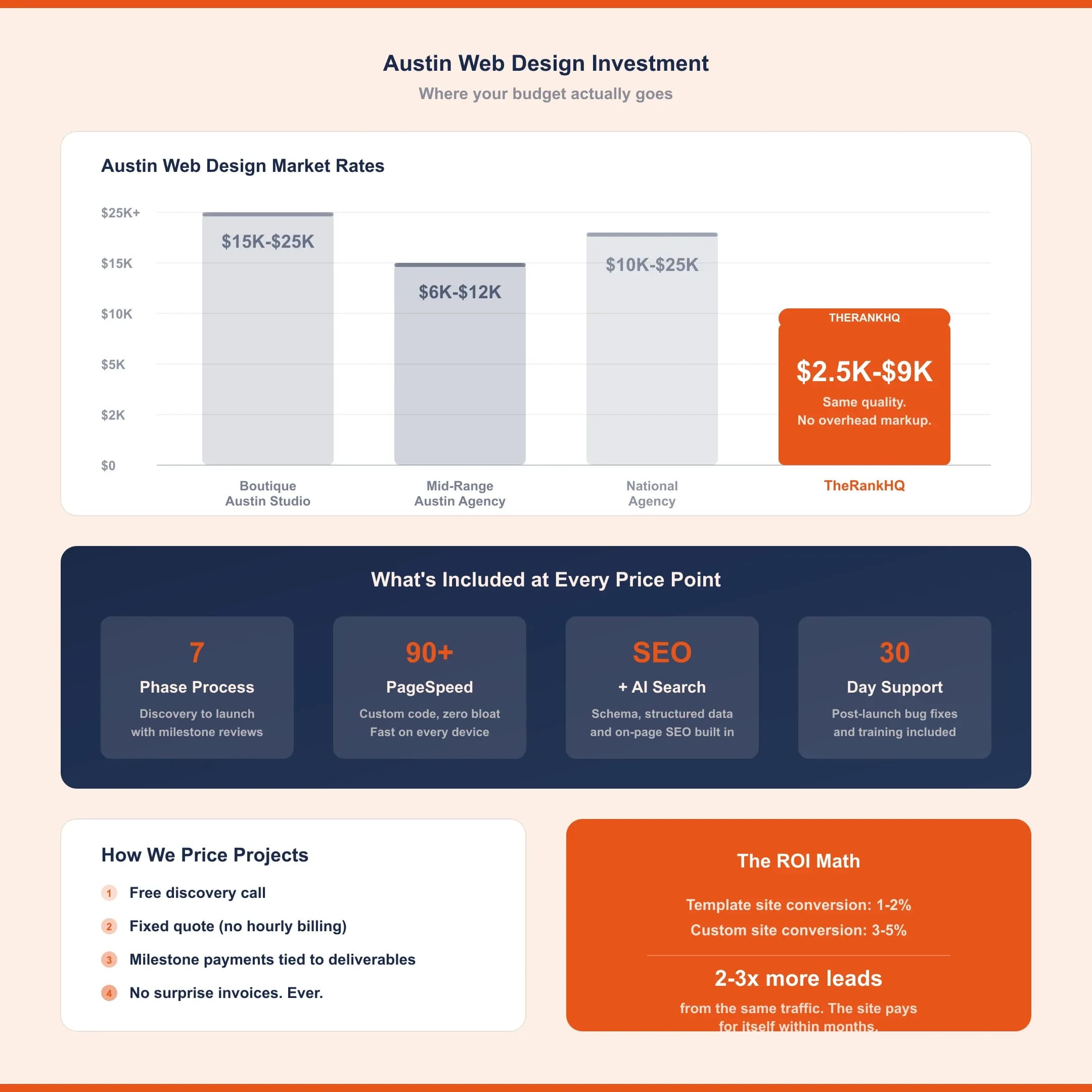
Austin has the most expensive web design market in Texas. The average hourly rate for an Austin web design company is $111 per hour, and local agencies typically charge $6,000 to $12,000 for a custom small business site, with boutique studios running $15,000 to $25,000+ (Source: TechBehemoths, Clutch.co, PrimeWebDesign).
What drives that number? Site complexity, page count, ecommerce vs lead generation, custom integrations, and content needs. A 6-page service site is a different project than a 40-page SaaS marketing site with API docs.
TheRankHQ's model is project-based and fixed. After a discovery call, you get a flat quote with milestone payments tied to deliverables. No hourly billing, no retainers. Our typical Austin projects range from $2,499 to $8,999 because the budget goes to design and code, not Domain office rent.
The ROI math is simple. Template sites convert at 1 to 2%. A custom site with conversion architecture is built to lift that. Most projects launch in 2 to 6 weeks.
We don't push one CMS on every client. We pick the platform that fits your business, your team's technical comfort, and your growth plan.
WordPress
Shopify
Magento
Drupal
Joomla
Squarespace
HubSpot
WordPress
Shopify
Magento
Drupal
Joomla
Squarespace
HubSpot
WordPress
Shopify
Magento
Drupal
Joomla
Squarespace
HubSpot
WordPress
Shopify
Magento
Drupal
Joomla
Squarespace
HubSpot
JavaScript
Python
Java
HTML5
CSS3
React
Vue.js
Angular
Node.js
JavaScript
Python
Java
HTML5
CSS3
React
Vue.js
Angular
Node.js
JavaScript
Python
Java
HTML5
CSS3
React
Vue.js
Angular
Node.js
JavaScript
Python
Java
HTML5
CSS3
React
Vue.js
Angular
Node.js
AI Search Platforms
Austin Buyers Ask ChatGPT First. Your Website Should Be the Answer
Austin is an early-adopter town, and its buyers ask ChatGPT before they ask Google. Every site we build is structured so AI search engines can find and quote it.
Why Choose Us
What Makes Our Austin Web Design Firm Different
You have dozens of Austin web design agencies to choose from. Here's what makes us different from the ones quoting $15,000 for the same work.
Readable by People and AI
Your next customer may never see a results page. Someone who moved to Austin last month asks an AI assistant who to call, and it answers from sites it can parse. We design for the person and structure for the machine on every page.
Research Before Design
We do not open Figma until your competitors are audited and your conversion goals are written down. In a market where new companies launch constantly, looking good is common. Saying the right thing to the right buyer is what separates you.
Code Without the Plugin Pile
Every build is custom code. No page builder, no theme framework carrying features you will never switch on. You get faster pages, fewer updates to chase and a site your own developers can read if you hire them later.
A Flat Quote, Not Hourly
You get one fixed price between $2,499 and $8,999 after the discovery call, and it does not grow by the hour. The average Austin web design firm bills about $111 an hour, so a fixed scope is the simplest way to know what you will spend.
Search Built In, Not Upsold
Schema markup, on-page SEO and the structure AI search needs ship with every site. You are not handed a finished design and then a second proposal. If you want continued work on rankings after launch, our local SEO service picks up from there.
Thirty Days of Support After Launch
You are not on your own on day one. Your project comes with 30 days of post-launch support covering bugs, content tweaks and CMS questions, which spans the stretch when your team is learning the editor and real visitors are finding edge cases.
Myth Buster
Web Design Advice Austin Founders Should Stop Trusting
We hear the same misconceptions from Austin business owners every week. Here are five that cost real money when they go unchecked.
A landing page is enough for a startup.
A landing page is fine for testing an idea. But if you're raising money, acquiring customers, or hiring, investors and prospects will look for a real site. A one-pager signals "we just started." A structured multi-page site signals "we're building something real." In Austin's competitive startup scene, that perception gap matters.
Custom web design takes 6 months.
That might have been true at agencies billing hourly with no incentive to finish. Project-based builds with milestone deadlines typically launch in 2 to 6 weeks. Discovery to live site. The timeline depends on how fast you approve wireframes and deliver content, not how slowly the agency works.
We can just use Canva or Wix and build it ourselves.
You can. And for a solo side project, that might work. But if your Austin business depends on being found online, converting visitors, and competing with companies that invested in proper design, a DIY builder creates a ceiling you'll hit quickly. No custom schema, limited SEO control, no conversion architecture. The cost savings disappear when the site doesn't generate leads.
SEO is something you add after the site is built.
Bolting SEO onto a finished site is like soundproofing a house after the walls are up. URL structure, heading hierarchy, internal linking, schema markup, and page speed optimization need to be built into the site at the code level. Retrofitting costs more and delivers less.
Testimonials
What Business Owners Say About Our Web Design Company
Real feedback from businesses that hired us for web design, redesign, and development projects.
Karim T★★★★★Website Design
Hello nadeem really helped us for the sites. He helped us until the last modification, he is really listening to the customers I was really happy to work with him. I will work with him again soon
Ray Roy★★★★★Website Design
TheRankHQ delivered exactly what was needed, satisfying the client's needs. The team managed the project well, they completed the task on time without any issues or mistakes. What was most impressive about TheRankHQ was their professional culture and behavior.
Thanh Trinh★★★★★Guest Post Outreach
service quality is very good. He helped me a lot in the backlink building process.
Frequently Asked Questions
Austin Web Design Company FAQs: Cost, Timeline and Process
Real questions Austin business owners ask before starting a web design project. Answered with specifics, not marketing fluff.
Who is TheRankHQ, and what do you get from its Austin web design service?
TheRankHQ is a web design agency that builds custom-coded, mobile-first websites for Austin businesses in healthcare and medical practices, real estate and property, and restaurants and hospitality. Most projects cost $2,499 to $8,999 at a fixed quote and launch in 2 to 6 weeks. Every build includes a sitemap, wireframes, design mockups, the finished site on WordPress, Shopify, Webflow or a headless CMS, CMS training and 30 days of support. SEO, schema markup and AI search structure are built in, not added later. Copywriting and hosting are not included; both are available at an extra charge.
How much does web design cost in Austin, TX?
A custom website from TheRankHQ costs $2,499 to $8,999 as a fixed project quote. Austin runs higher than the rest of Texas: local agencies typically quote $6,000 to $12,000 for a custom small business site, and boutique studios go past $15,000. Your number depends on how many pages you need, whether you sell online and what the site has to connect to. Hosting and copywriting are priced separately, each at an additional cost.
How long does it take to build a website for an Austin business?
Plan on 2 to 6 weeks from kickoff to go-live for most sites. A six-page service site with content ready sits at the fast end, and a larger SaaS marketing site with integrations takes closer to six weeks. Austin agency pages commonly quote four to six weeks for a standard build and two to three months for ecommerce. Your approval speed on wireframes and designs is the biggest variable, so review dates are agreed at kickoff.
Do I need an Austin web designer I can meet in person?
No, a web project does not need in-person meetings to go well. TheRankHQ works remotely with companies across the US, running discovery, design reviews and training by video with shared Figma files. A local Austin web designer makes sense if you want someone on site for photography or workshops. For strategy, design, code and SEO, what matters is the research into your market and a process you can follow week by week.
What does a Texas real estate broker's website need on its homepage?
A Texas broker's business website needs two homepage links required by the Texas Real Estate Commission: one to the Consumer Protection Notice and one to a completed Information About Brokerage Services form. TREC specifies the link wording and a minimum font size, and both links must be readily noticeable. We place them in the layout from the wireframe stage, alongside IDX search, neighborhood pages and lead forms for the Austin market. Confirm current wording with your sponsoring broker.
Do Texas plumbers and HVAC contractors have to show a license number on their website?
Yes. Texas plumbing companies must state the Responsible Master Plumber's license number in all advertising regardless of the media used, and the state lists a missing license number in an air conditioning contractor's advertisement as a violation. A website is advertising, so the number belongs in the header or footer of every page. On an Austin home services site it gets planned into the layout with service-area pages, click-to-call buttons and a quote form. Treat this as general information and check the current rule with your regulator.
Does a web design quote in Austin include writing the content?
Usually not, so ask before you compare quotes. Low Austin quotes often assume you will supply the text, and the same is true of ours: copywriting is not included and is available for an extra charge. What the project does include is a content plan for each page, covering the sections, headings and questions the copy has to answer, so whoever writes it starts from a clear outline.
Is SEO included in your Austin web design services?
Yes. Every site is built with on-page SEO, structured data and AI-search formatting, none of it sold separately. That covers page titles, headings, internal linking, image optimization, structured data and analytics setup. Ongoing campaigns such as link building or monthly content are separate work, and no honest firm can promise a ranking. In a competitive Austin category, treat the build as the foundation and plan continued effort on top of it.
How do I keep a website project from dragging on for months?
Fix the scope, the price and the review dates before any work starts, whichever Austin web design company you hire. Client reviews in Clutch's Austin web design listing mention delayed completion and missing phase timelines, and both usually trace back to open-ended scope. TheRankHQ runs seven phases in a set order, with something for you to approve at the end of each: brief, sitemap, wireframes, mockups, built site. Most projects finish in 2 to 6 weeks.
Is a landing page enough for an Austin startup, or do we need a full site?
A landing page is enough while you are testing demand. A full site becomes necessary once you are raising money, hiring or selling to companies that vet vendors, because investors and buyers look for product, pricing, security and team pages before taking a meeting. For an early-stage Austin company the practical route is a compact, multi-page custom site on a CMS that can grow, instead of a one-pager you replace within the year.
Who owns the site, and where is it hosted?
The website, its code and the domain all belong to you. Hosting is your choice: it is not bundled into the project, and we can arrange it for an extra charge or deploy to an account you already have. Because the site runs on WordPress, Shopify, Webflow or a headless CMS, you can move it or hire another developer at any time. Nothing depends on a proprietary system.
What support do I get once my Austin site is live?
You get 30 days of post-launch support, CMS training and full access to everything. During those 30 days we fix bugs, make small adjustments and answer editor questions. Your team leaves training able to add pages, update menus or pricing, and publish posts unaided. If a busy stretch like SXSW or ACL is coming, launching a few weeks ahead means the support window covers your first traffic spike.
How do I get my Austin business recommended by ChatGPT?
Start with a site AI tools can read. AI assistants and Google's AI Overviews draw on pages with clear headings, schema markup and direct answers, so we build all three into each page. Keep your business details consistent across your Google Business Profile and directories as well. No one can promise a citation, but structured sites are the ones assistants are able to quote. For the ongoing side, see AI search optimization.
Stop Losing Austin Customers to a Better-Looking Competitor's Website
SnapPDF's custom-built site ranked for 13,800 keywords and generates 10,400+ monthly organic visitors. Same process, same team, available for your Austin business.